A recycled-plastic quote can look competitive and still be commercially unusable.
One supplier quotes rPET pellet delivered to your factory. Another quotes hot-washed flake at the port. A third offers “food-grade recycled PET” without stating the approved process, intrinsic viscosity, colour limit or chain-of-custody evidence. The prices may all be expressed per tonne, but they do not describe the same product or risk.
That is the central problem in recycled-plastic procurement: a price is only comparable when the material, specification, evidence and delivery basis are comparable.
A strong request for quotation, or RFQ, does more than ask for a price. It defines what the converter can run, what the compliance team can approve, what the supplier must prove and how non-conforming deliveries will be managed.
This guide provides a practical global RFQ framework for rPET, rHDPE and rPP pellets, flakes and—where relevant—baled feedstock.
Why recycled-plastic quotations are difficult to compare
Virgin resin is usually sold against a relatively controlled grade. Recycled material carries additional variation from its feedstock, sorting system, washing process, filtration, decontamination technology and previous product life.
Two materials described simply as “recycled HDPE” may differ in:
- Post-consumer versus post-industrial origin
- Natural, white, mixed or coloured feedstock
- Food-contact status
- Pellet, regrind, flake or bale form
- Melt flow rate, density, odour and colour
- Moisture, fines, metals and non-target polymers
- Certification and chain-of-custody coverage
- Delivery basis, freight, duty and packaging
If those differences remain hidden until production trials, the lowest quoted price can become the highest total cost.
The recycled plastic RFQ checklist
Use the following fields in every RFQ. Mark each requirement as mandatory, preferred or supplier to propose. This prevents a desirable feature from being mistaken for a contractual acceptance condition.
| RFQ section | What the buyer should specify | Why it matters |
|---|---|---|
| Polymer and grade | rPET, rHDPE or rPP; food or non-food; PCR or PIR | Stops unlike materials being quoted as substitutes |
| Physical form | Bale, hot-washed flake, regrind, pellet or compound | Each form sits at a different processing and cost stage |
| Application | Bottle, sheet, fibre, injection moulding, extrusion, pipe or other use | Allows the supplier to match process and performance requirements |
| Technical limits | IV or MFR/MFI, density, colour, moisture, contamination, filtration and odour | Defines what the plant can process consistently |
| Compliance | Intended market, food-contact status, restricted substances and declarations | Prevents certificates being assumed to cover the wrong product or jurisdiction |
| Recycled-content evidence | PCR percentage, calculation method, chain of custody and certificate scope | Supports customer and regulatory claims |
| Commercial basis | Currency, unit, Incoterm, location, freight, duty and payment terms | Makes prices genuinely comparable |
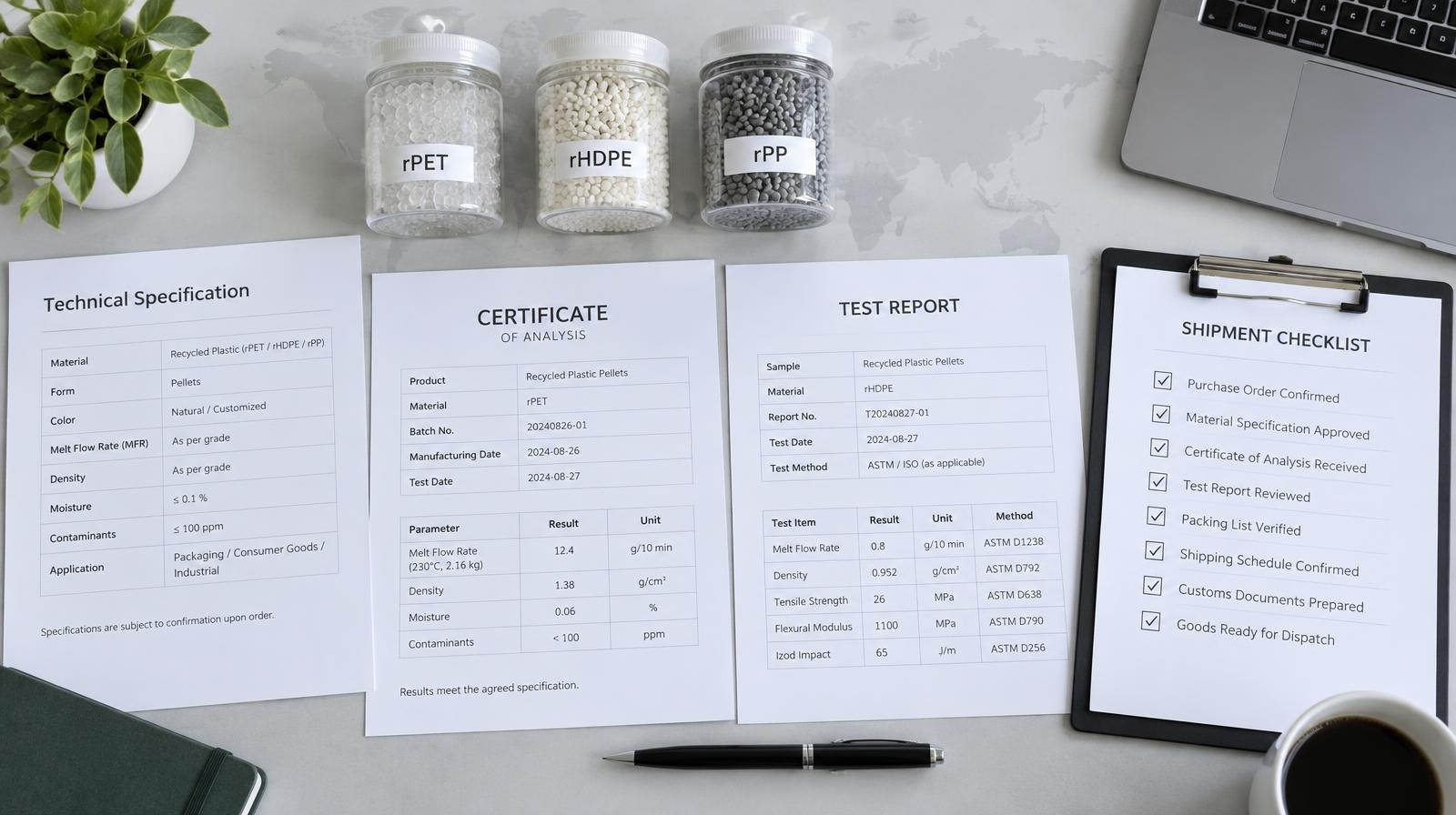
| Quality evidence | Certificate of analysis, test method, frequency and retained samples | Shows whether the quoted specification is routinely controlled |
| Trial and approval | Sample size, plant-trial quantity, approval gates and change control | Separates initial interest from production approval |
| Non-conformance | Notification, quarantine, claim period, replacement and credit process | Prevents disputes after a rejected load |
Step 1: define the material without shortcuts
Start with a product description that cannot be misunderstood.
Instead of requesting “100 tonnes of recycled PET,” specify something such as:
Post-consumer clear rPET pellet for non-food sheet extrusion, supplied in one-tonne bags, with the required IV, colour, moisture, filtration and contamination limits listed in the attached specification.
For every polymer, state:
- Polymer: PET, HDPE or PP.
- Origin: post-consumer recycled, post-industrial recycled or an allowed blend.
- Grade: food-contact or non-food; bottle, sheet, fibre, injection or extrusion grade.
- Colour: clear, natural, white, light-coloured, mixed-colour or a defined colour range.
- Form: bale, flake, regrind, pellet or compounded pellet.
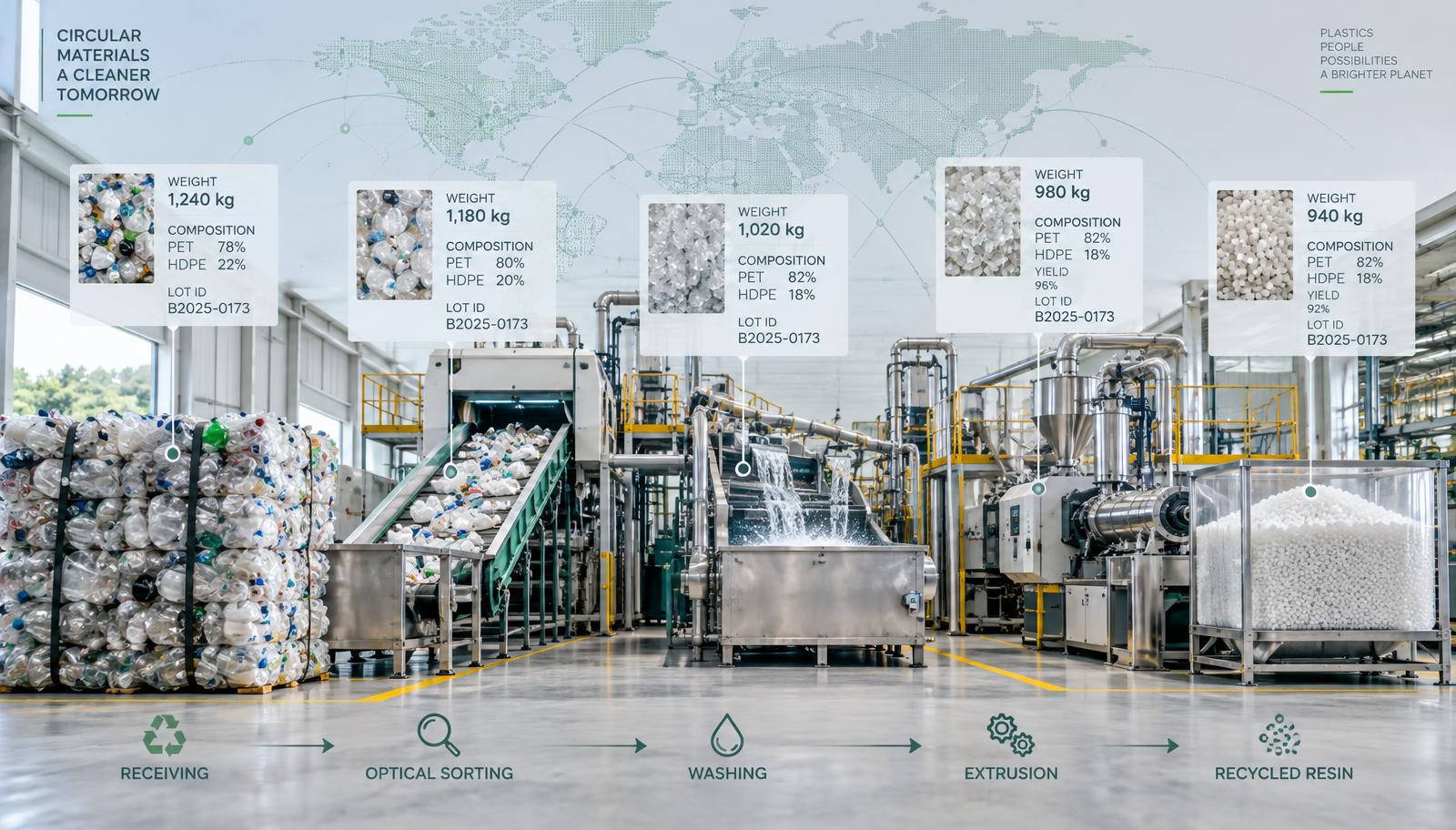
Do not allow the quotation to switch forms silently. A flake price should not be compared directly with a pellet price: pelletising adds drying, extrusion, filtration, testing and—where applicable—decontamination and solid-state processing.
Step 2: specify the properties that control production performance
The correct technical fields depend on the polymer and application.
rPET
Common requirements include intrinsic viscosity, colour values, moisture, bulk density, PVC, polyolefins, metals, fines, black specks, acetaldehyde and filtration. Food-contact applications also require evidence that the specific recycling process and supplied grade are suitable for the intended use and market.
rHDPE
Buyers commonly assess melt flow rate, density, colour, ash, moisture, odour, black specks, gels, filtration and stress-crack performance. Natural non-food pellet is not automatically food grade, even when the feedstock originated from milk bottles.
rPP
Important fields may include melt flow rate, impact or stiffness performance, ash and filler content, colour, odour, moisture, filtration and the presence of polyethylene or other non-target polymers.
For every numerical limit, name the test method where possible. A value without a method, conditioning requirement or test frequency can create false precision.
Step 3: separate product compliance from recycled-content certification
These are related, but they are not the same question.
Product compliance asks whether the material is suitable for the intended application. Recycled-content certification asks whether the claimed recycled origin and percentage can be traced and verified.
APR describes its PCR Certification as a chain-of-custody assessment that can validate post-consumer recycled content from flake or pellet through to the finished product. RecyClass operates recycled-plastics traceability certification in Europe. Other schemes may be appropriate in different markets or supply chains.
The buyer should verify:
- The certificate holder matches the contracting or producing entity.
- The production site is within the certificate scope.
- The certificate covers the relevant polymer, form and process.
- The certificate is current for the proposed supply period.
- Transaction or batch evidence can connect the shipment to the claim.
A valid certificate for rPET flake from one facility does not automatically approve rPET pellet from another facility. For the records that connect each lot back to its feedstock, see our guide to recycled-plastic traceability.
Step 4: request comparable commercial terms
Every supplier should return the same price fields:
- Currency and unit, such as EUR/metric tonne or US cents/lb
- Quoted quantity and volume band
- Delivery basis: EXW, FOB, FCA, CFR, CIF, DDP or another clearly defined term
- Named origin, port or delivery location
- Packaging and pallet costs
- Freight, insurance, duty and taxes included or excluded
- Payment terms and credit requirements
- Minimum order quantity and lead time
- Quote validity and proposed indexation method
If the price is linked to ICIS, Platts, Argus, OPIS or another assessment, name the exact polymer, grade, form, geography, basis, averaging period and adjustment formula. “Market price plus conversion” is not an auditable pricing mechanism.
Use the Global Recycled Plastic Price Centre to sense-check regional market direction, but do not replace a like-for-like supplier quotation with a benchmark for another grade or form. Our guide on how to compare recycled-plastic price assessments explains what each benchmark field means.
Step 5: build approval gates into the RFQ
A certificate and laboratory sample are not the same as stable production supply. Use staged approval:
Gate 1: document review
Confirm the technical data sheet, safety data, declarations, certificate scope, process description, capacity, lead time and proposed commercial basis.
Gate 2: representative sample
Agree how the sample was produced and whether it represents routine production. Record the lot, date, plant and test results.
Gate 3: plant trial
Run enough material to expose drying, conveying, filtration, colour, odour, process stability, scrap and finished-product performance. Define acceptance criteria before the trial begins.
Gate 4: controlled commercial order
Start with a defined quantity and enhanced inspection. Link the shipment, supplier lot, incoming checks, process results and customer output.
Gate 5: ongoing supplier approval
Track conformance, claims, delivery reliability and lot-to-lot variation. Require notification before changes to feedstock source, process, site, additive package or specification.
Compare total usable cost—not just the invoice price
The economically relevant measure is the cost of material that becomes acceptable finished product.
Usable material cost = landed purchase cost + handling + processing losses + scrap + downtime + claims + disposal, divided by saleable output.
A resin priced US$50/t below another offer is not cheaper if it creates additional screen changes, colour losses, rejects or line instability.
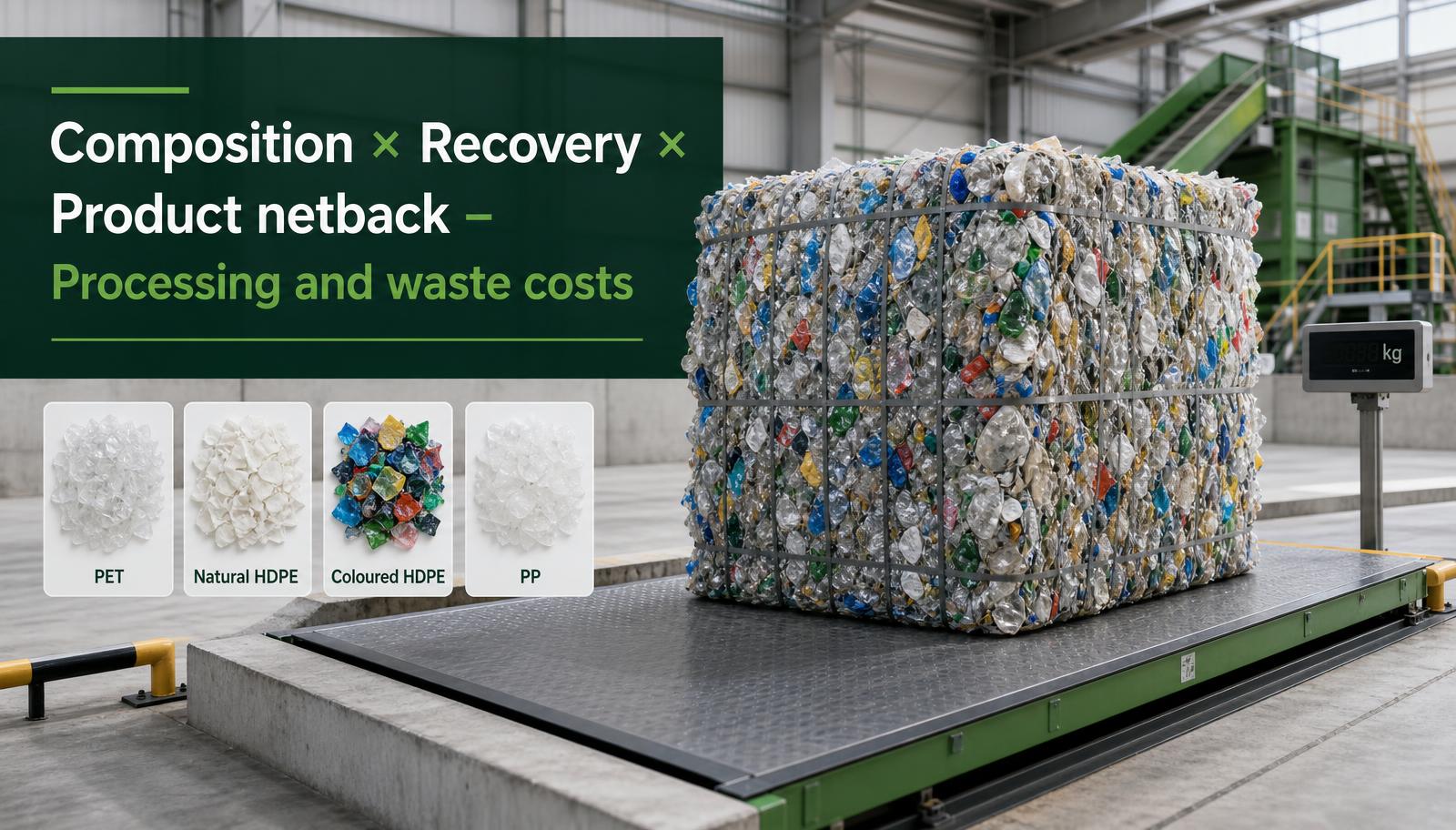
For bale and flake purchases, model recoverable yield explicitly. The Bale Valuation Calculator can help convert composition, recovery and waste costs into a maximum rational purchase price.
Red flags in recycled-plastic quotations
Pause the approval process when:
- “Food grade” is stated without application-specific compliance evidence.
- PCR and PIR are used interchangeably.
- The certificate belongs to another company, site, polymer or process.
- The quotation omits physical form or colour.
- A delivered price does not name the destination.
- The supplier will not disclose test methods or batch variation.
- The trial sample cannot be connected to routine production.
- The supplier can change feedstock or process without notifying the buyer.
- The quote compares a bale, flake or regrind with finished pellet as though they were equivalent.
Where BaleScan supports the qualification process
BaleScan Pro can support the inbound feedstock-control layer of supplier management by creating consistent photo-based composition estimates, contamination observations and shareable bale reports.
That can help teams screen deliveries, organise quality evidence and identify supplier trends before feedstock enters production. For laboratory and sampling methods, see how to verify plastic recycling purity. It does not replace contractual sampling, laboratory testing, food-contact approval or the buyer's formal supplier-qualification process.
The strongest workflow connects bale observations to supplier, load, processing yield and finished-resin quality. That turns an RFQ specification into a measurable operating standard rather than a document that is reviewed only when a claim occurs.
Frequently asked questions
What should a recycled-plastic RFQ include?
It should define the polymer, recycled origin, grade, colour, physical form, application, technical limits, test methods, certification, delivery basis, price unit, trial process and non-conformance terms.
Can I compare recycled flake and pellet prices directly?
No. Flake and pellet represent different processing stages. Pellet pricing includes additional drying, extrusion, filtration, quality control and potentially decontamination or solid-state processing.
Does a recycled-content certificate prove the resin meets my specification?
No. Certification may verify origin and chain of custody, but the buyer still needs to approve technical performance, compliance and consistency for the intended application.
What documents should a PCR supplier provide?
Typically: technical and safety data, a certificate of analysis, applicable compliance declarations, recycled-content or chain-of-custody evidence, site and process details, lot identification and change-notification commitments.
How should recycled resin quotations be compared?
Normalise the polymer, grade, form, region, delivery basis, currency, unit, quantity, packaging and payment terms. Then compare landed cost and expected usable yield—not headline price alone.
Can BaleScan approve a recycled-plastic supplier?
No. BaleScan supports repeatable visual screening and documentation of baled feedstock. Formal approval should still use agreed sampling, laboratory testing, process trials, compliance review and supplier-audit controls.
Sources
- Association of Plastic Recyclers — PCR Certification
- APR — Expanded PCR Certification standard for recycled content in products, July 2026
- RecyClass — Recycled Plastics Traceability Certification
- Sustainable Packaging Coalition — Guide to Recycled Plastics for Packaging, Part II
- S&P Global — Recycled Polymers 2026
General market and procurement information only. Not legal, compliance or certification advice.