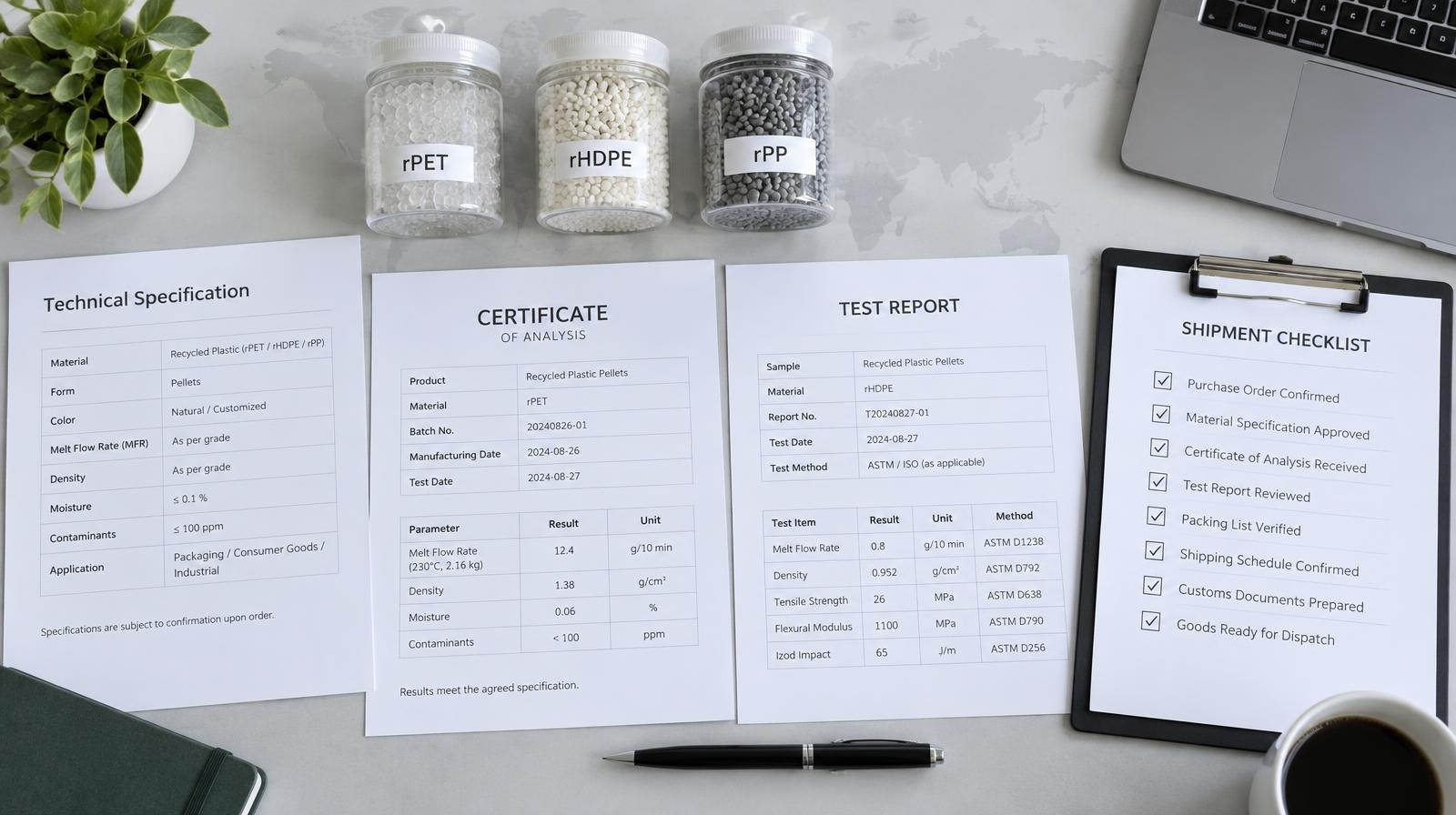
Recycled-content demand is changing what buyers expect from plastic recyclers. A certificate stating that a resin is recycled may no longer answer the commercial questions behind a purchase: Where did the feedstock come from? Was it post-consumer material? Which loads contributed to the finished lot? How were contamination, yield and losses measured? Can the claim survive an audit?
These questions are becoming more urgent as regulations and customer specifications move from voluntary commitments towards documented recycled-content requirements. The European Union’s Packaging and Packaging Waste Regulation (PPWR), for example, has applied since 12 August 2026 and requires manufacturers and importers to demonstrate relevant packaging requirements through technical documentation. Its detailed methodology for calculating and verifying recycled content is due by 31 December 2026. Trade rules are tightening in parallel — see our guide to the EU plastic waste export ban 2026.
The commercial effect will not stop at Europe. Resin and packaging supply chains are international. A recycler in Asia, North America, Latin America, Africa or the Middle East may need to provide evidence to a converter whose packaging ultimately enters the EU—or to a global brand applying one documentation standard across multiple markets.
The practical response is not to collect every possible data point. It is to create a reliable chain of evidence connecting incoming bales, processing outcomes and outgoing resin lots.
What recycled plastic traceability actually means
Traceability is the ability to follow material and its associated evidence through each material change.
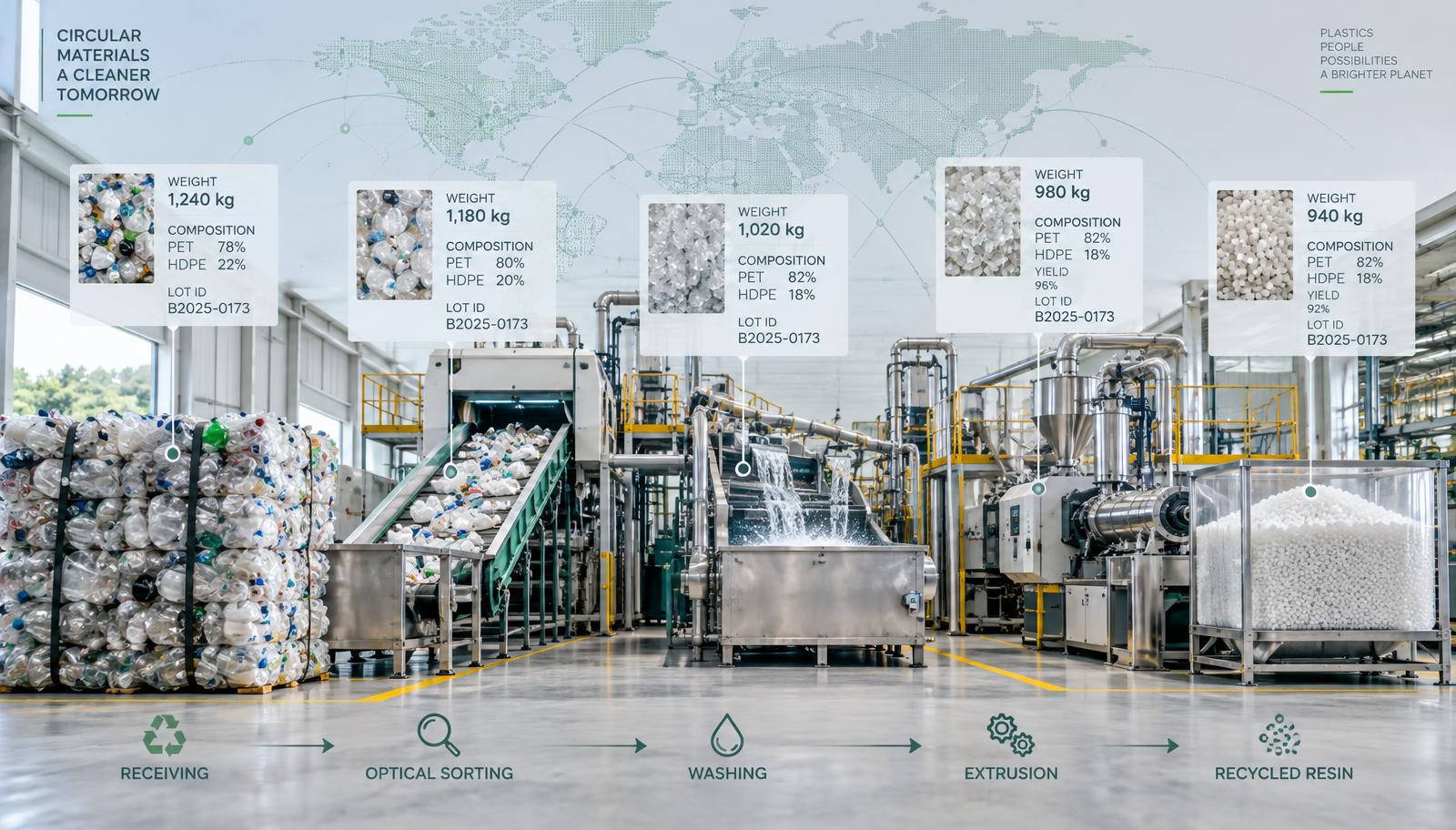
For a mechanical recycling operation, that chain commonly runs through:
- feedstock supplier and shipment;
- received bale or loose-material lot;
- composition or quality inspection;
- sorting, grinding and washing batch;
- flake or regrind intermediate lot;
- extrusion and pellet batch; and
- dispatch to the resin buyer.
Traceability does not mean that every pellet must be linked to one individual bale. Plants blend material, run continuous processes and carry work-in-progress. The system needs a defensible method for identifying contributing input lots, reconciling quantities and documenting how materials were combined. Strong evidence combines unique identifiers, dated transactions, measured quantities, quality results and controlled links between records.
Why this is becoming a purchasing requirement
The PPWR establishes minimum post-consumer recycled-content percentages for plastic packaging from 2030, or three years after the relevant implementing methodology enters into force if that is later. The 2030 levels include 30% for contact-sensitive PET packaging other than single-use beverage bottles, 30% for single-use plastic beverage bottles and 35% for other plastic packaging, subject to the regulation’s scope and exceptions.
The regulation also addresses material collected or recycled outside the EU. Third-country supply must meet equivalent collection and environmental conditions, with the Commission due to establish a methodology for assessment, verification and certification—including possible third-party audits.
That creates a clear signal for global suppliers: origin, process and quantity evidence may influence market access, customer approval and the value of recycled resin.
It also has immediate commercial uses:
- investigating a failed colour, odour or contamination result;
- separating supplier performance instead of averaging every load together;
- reconciling purchased bale weight with saleable flake or pellet output;
- supporting post-consumer recycled-content claims;
- identifying finished lots affected by a feedstock problem; and
- answering customer questionnaires without rebuilding records manually.
The minimum viable bale-to-pellet record
Different regions and facilities may use different software, but the essential record should remain consistent.
| Stage | Minimum information to capture | Commercial reason |
|---|---|---|
| Supplier and shipment | Supplier ID, origin country or region, collection route or source category, shipment date, docket or reference number | Establishes provenance and supports supplier comparison |
| Bale receipt | Unique load or lot ID, polymer and grade, claimed weight, verified received weight, bale count, photos | Creates the first controlled material record |
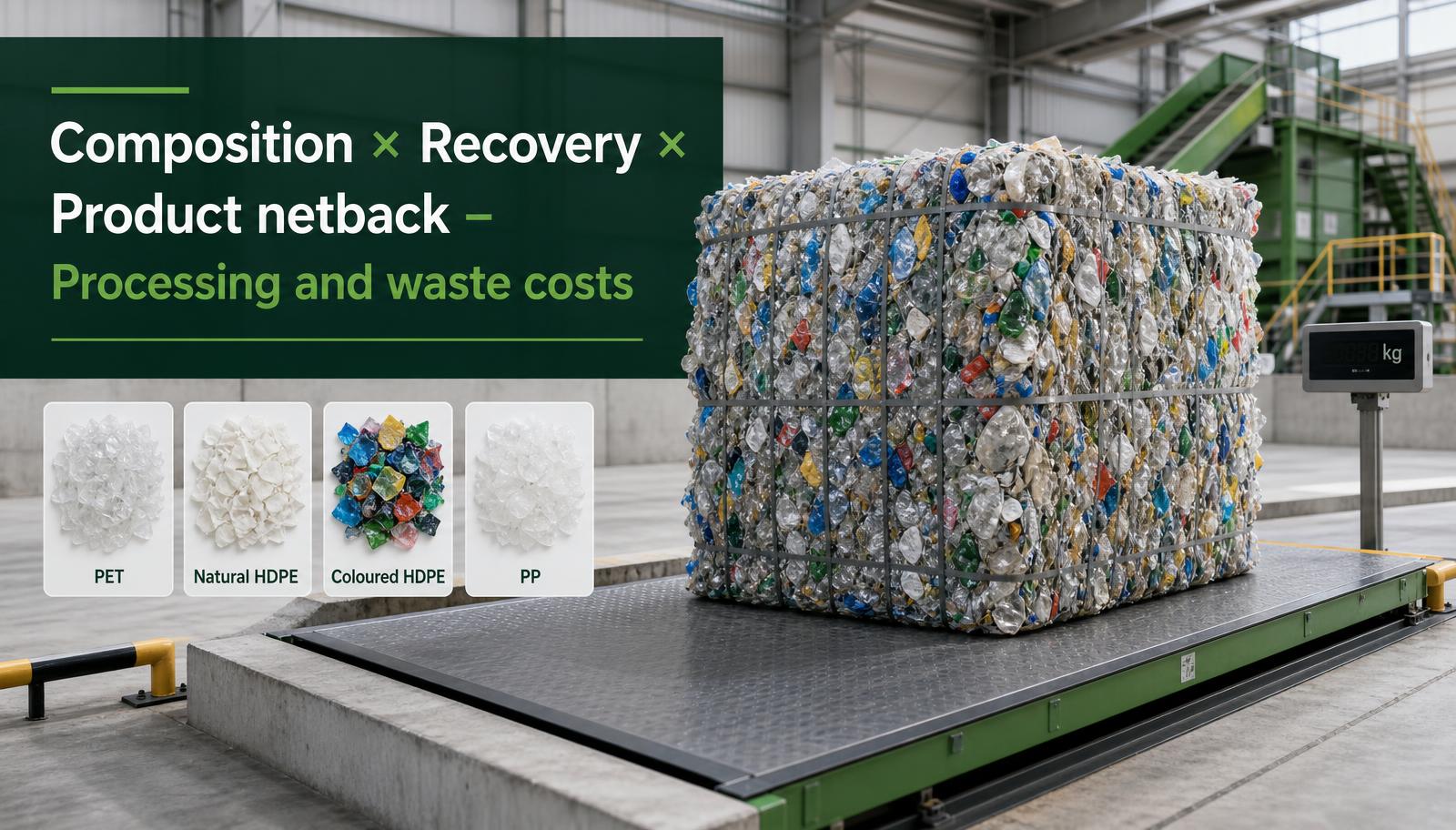
| Quality inspection | Sampling method, estimated or measured composition, moisture, prohibited items, colour mix, non-target polymers | Links purchase value to usable material rather than gross tonnes |
| Sorting and washing | Input lot IDs, run date, input weight, rejects, process losses, flake output, key quality tests | Demonstrates transformation and calculates recoverable yield |
| Extrusion | Flake lot IDs, additives or blend inputs, pellet batch ID, output weight, off-spec quantity, test results | Connects processed feedstock to finished resin |
| Dispatch | Customer order, resin specification, batch IDs, dispatched weight, certificate or declaration | Completes the chain from source to buyer |
This is not a complete certification standard. Food-contact applications and regulated packaging may require migration testing, decontamination-process evidence, accredited laboratory results or third-party certification.
Four controls that make traceability credible
1. Give every load and production batch a unique identity
Assign a unique identifier at receipt and carry it into inspection records, claims, photos and processing documentation. When loads are blended, record every contributing ID and the production window.
2. Preserve mass balance at the plant level
For each relevant period, reconcile:
Opening inventory + received material = processed material + closing inventory + documented losses
Then reconcile the process:
Input weight = saleable output + rejects + moisture or process loss + work-in-progress change
Weighbridge tolerances, moisture and continuous production create differences. Define acceptable tolerances, investigate exceptions and retain corrections. Also distinguish mass balance from physical segregation: record the governing scheme and allocation rules, and never describe blended material as segregated.
3. Link quality evidence to the correct material
Every inspection, photo, test result and corrective action should reference the applicable load, intermediate lot or finished batch. Record the sampling method because a surface image, manual sample and full composition audit provide different confidence levels.
4. Control corrections and missing data
Use mandatory fields, permissions and an audit trail showing who changed a value, when and why. If evidence is unavailable, mark it unknown and follow a documented disposition rule. A visible gap is safer than an unsupported assumption entering a recycled-content claim.
Turn bale quality data into financial information
Traceability becomes commercially powerful when it connects quality with yield and price. Two PET bottle-bale suppliers may quote the same price per metric tonne yet deliver different moisture, contamination and hot-washed flake yields. Equal bale prices do not necessarily produce equal resin costs.
Track these measures by supplier and grade:
- landed bale cost and delivery basis;
- target-polymer composition and moisture;
- sorting, washing and extrusion yield;
- disposal or reject cost; and
- off-spec or downgrade rate.
This supports a more useful metric:
Recovered feedstock cost per tonne of saleable output = (total landed input cost + processing costs + reject costs) ÷ saleable output tonnes
Adapt the calculation to the plant’s accounting boundary, but compare suppliers on recovered value—not simply bale price. Use the Global Price Centre for public recycled-plastic pricing observations, the rPET Pricing Tracker for PET bottle-bale and rPET prices, and the Contamination Cost Calculator to model bale contamination cost.
A practical implementation plan
Start with one polymer and one line
Choose one important stream, such as clear PET or natural HDPE bottle bales. Map identifiers and handovers from receiving to finished output, finding where the chain breaks before adding technology.
Define the claim before designing the data
“Recycled,” “post-consumer recycled,” “food-grade” and “physically segregated” are different claims. Define the exact claim, market and evidence owner before designing the record.
Agree tolerances and escalation rules
Set rules for missing origin evidence, weight variances, contamination and off-spec material. Tell operators whether to accept, downgrade, quarantine, resample, reject or seek more evidence.
Test backward and forward tracing
Select one pellet batch and trace backwards to all possible feedstock lots. Then select one bale load and trace forwards to its possible intermediates and finished batches. Record the time taken and unresolved gaps.
Keep evidence exportable
Maintain an exportable lot summary containing identifiers, dates, weights, declared origin, quality checks, process links and supporting documents. Avoid locking evidence inside messages or individual inboxes.
Where BaleScan can support the evidence chain
BaleScan Pro’s visual screening and bale-composition reporting can support consistent intake checks, helping teams organise photographic and quality observations against a repeatable audit workflow. It should be used as one layer within the quality and traceability system—not as a substitute for representative sampling, laboratory testing, certification or the legal documentation required for a regulated claim.
When bale observations are connected to load IDs, supplier performance, processing yield and final quality, the images become more than inspection records. They help explain why one feedstock stream produces better commercial outcomes than another.
The immediate regulatory driver may be European, but the opportunity is global. Suppliers providing structured origin, quantity, quality and process evidence will be easier to approve and retain. The objective is a controlled chain in which each material claim can be followed to a documented source, transformation and quantity—turning traceability into a tool for quality, procurement and margin protection.
Sources and further reading
- European Commission — Packaging and Packaging Waste Regulation overview
- EUR-Lex — Regulation (EU) 2025/40 on packaging and packaging waste
- The Circulate Initiative — How Traceability Can Shape the Future of Recycled Plastics Markets
- Association of Plastic Recyclers — APR PCR Certification
This article provides general market and operational information, not legal or certification advice. Requirements vary by product, claim, jurisdiction and supply-chain role.