A plastic bale is not worth its gross weight multiplied by a published resin price.
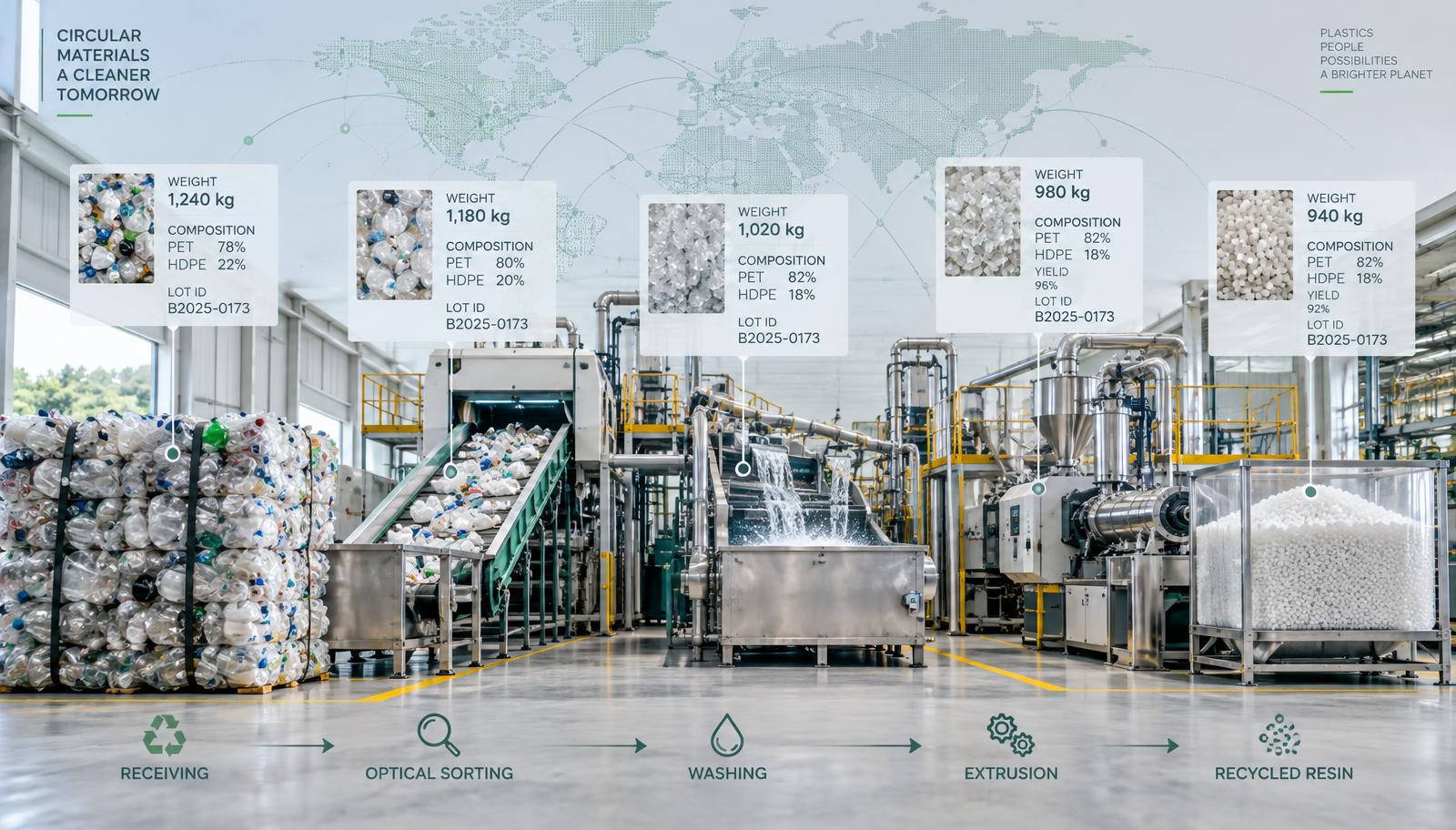
That shortcut ignores the difference between a bale, washed flake and finished pellet. It also assumes every kilogram in the bale will become saleable product—even though labels, liquids, fines, incompatible polymers, metals and other contaminants may be paid for, transported, processed and then discarded.
The commercially useful question is different:
What is the expected value of the saleable materials recovered from this bale, after processing, freight, disposal and risk?
That calculation matters in every market. Whether a facility buys PET bottle bales in North America, HDPE containers in Europe, mixed rigids in Asia or locally sourced PP, the same principles apply. Currency, specification and costs change; the valuation logic does not.
This guide explains that logic step by step.
Why there is no single plastic bale price
Public price reports can provide valuable market direction, but a quoted price only applies to the specification being reported. A PET bottle bale is not interchangeable with clear hot-washed PET flake. Natural HDPE bottles are not the same product as coloured rHDPE pellet. Food-contact resin carries different technical and regulatory requirements from non-food material.
Plastic bale value varies with polymer mix, target-material percentage, contaminants, moisture, colour, recovery efficiency, conversion and disposal costs, freight, saleable-output values and confidence that the load will match its declared grade.
Market conditions add another layer. OPIS described Europe entering 2026 under pressure from inexpensive virgin polymer, imports, oversupply and weak recycled demand. APR also reported in May 2026 that PET bale markets remained weak while HDPE and PP showed a different demand pattern. A valuation model therefore needs current, grade-specific market inputs—not a permanent price assumption.
Start with an agreed bale specification
A valuation is only defensible when buyer and seller are describing the same material.
The Association of Plastic Recyclers publishes model specifications for PET bottles, PET thermoforms, natural and coloured HDPE bottles, PP, mixed rigid plastics and several film grades. APR says these specifications are benchmarks for quality and market acceptance, not replacements for an individual buyer’s contract.
ReMA and APR updated several HDPE and film specifications in July 2025 to reflect current trading and reclaimer practice. Their guidance distinguishes included materials, contaminants tolerated at low levels and prohibited items that are difficult or dangerous to process.
Before assigning a value, record the bale grade, origin, weight, delivery basis, target polymers, contaminant rules, inspection method, quality-adjustment terms and pricing date.
Without this information, two parties can agree on a price and still disagree on what was purchased.
The plastic bale valuation formula
The calculation can be separated into four layers.
1. Estimate recoverable tonnes by material
For each material in the bale:
Recoverable tonnes = Bale weight × Material composition % × Recovery efficiency %
Composition is the estimated share entering the facility. Recovery efficiency is the share expected to survive processing and become saleable output. Keep them separate: high target-polymer content can still deliver poor recovery because of moisture, labels, fines, colour loss or process limitations.
2. Calculate gross recovered-product value
For every compatible saleable output:
Recovered-product value = Recoverable tonnes × Achievable product netback per tonne
Use the price for the product the facility can actually make and sell. Do not apply a premium food-grade pellet assessment to a bale if the process produces non-food flake. Do not use a Northwest European delivered pellet price for material sold ex-works in another region.
The most useful input is the achievable customer netback after any outbound freight, rebates, claims and selling costs. A public benchmark can inform this number, but it is not automatically the plant’s realised price.
3. Add or subtract the inbound gate position
Some bales are purchased from the supplier. In other arrangements, the processor receives a gate fee to accept the material.
Treat the cash direction clearly: a purchase price paid is a cost; a gate fee received is a benefit. With a negative price, state explicitly which party pays whom.
4. Deduct the full cost of conversion and risk
The calculation should include more than the wash-line operating rate.
Net bale contribution = Recovered-product value + Gate fee received − Bale purchase cost − Inbound freight − Processing cost − Waste cost − Other variable costs − Risk allowance
Risk allowance can reflect uncertainty around a new supplier or inconsistent stream, but should not hide poor data.
The seven inputs that determine value
| Input | What to use | Common valuation error |
|---|---|---|
| Bale weight | Verified net tonnes | Using nominal bale count without reconciling weight |
| Composition | Material percentages supported by inspection or sampling | Accepting the supplier’s grade description as a measurement |
| Recovery efficiency | Historical plant recovery for the same stream | Assuming composition percentage equals saleable yield |
| Product netback | Price achievable for the actual output, basis and date | Applying a pellet benchmark to bale or flake |
| Processing cost | Cost per inbound or saleable tonne, clearly labelled | Mixing the two denominators |
| Waste cost | Disposal tonnes × delivered disposal cost | Ignoring handling and freight to disposal |
| Freight and other costs | Contract-specific inbound and outbound costs | Comparing ex-works and delivered prices as though identical |
These inputs should be version-controlled. When a resin market moves, update the relevant output value. When plant yield improves, update the recovery assumption only after sufficient operating evidence.
Why contamination costs more than its weight
Contamination damages bale economics in several places at once.
The facility may pay for the contaminant in the purchase price. It then pays to transport and handle it. Sorting equipment and employees spend time removing it. The residue may attract another freight and disposal cost. At the same time, the contaminant displaces saleable polymer, spreading fixed processing costs across fewer output tonnes.
Some contaminants create disproportionate risk: incompatible polymers can damage finished quality, residual liquids add paid weight, metals can damage equipment, and prohibited items can trigger rejection. Identify the contaminant and assign its actual yield, handling and disposal consequences.
Use the contamination-cost calculator to test how purity gaps can affect monthly value.
Price every material in a mixed bale separately
A mixed plastic bale should not be valued using one blended resin price unless the buyer genuinely sells one blended output.
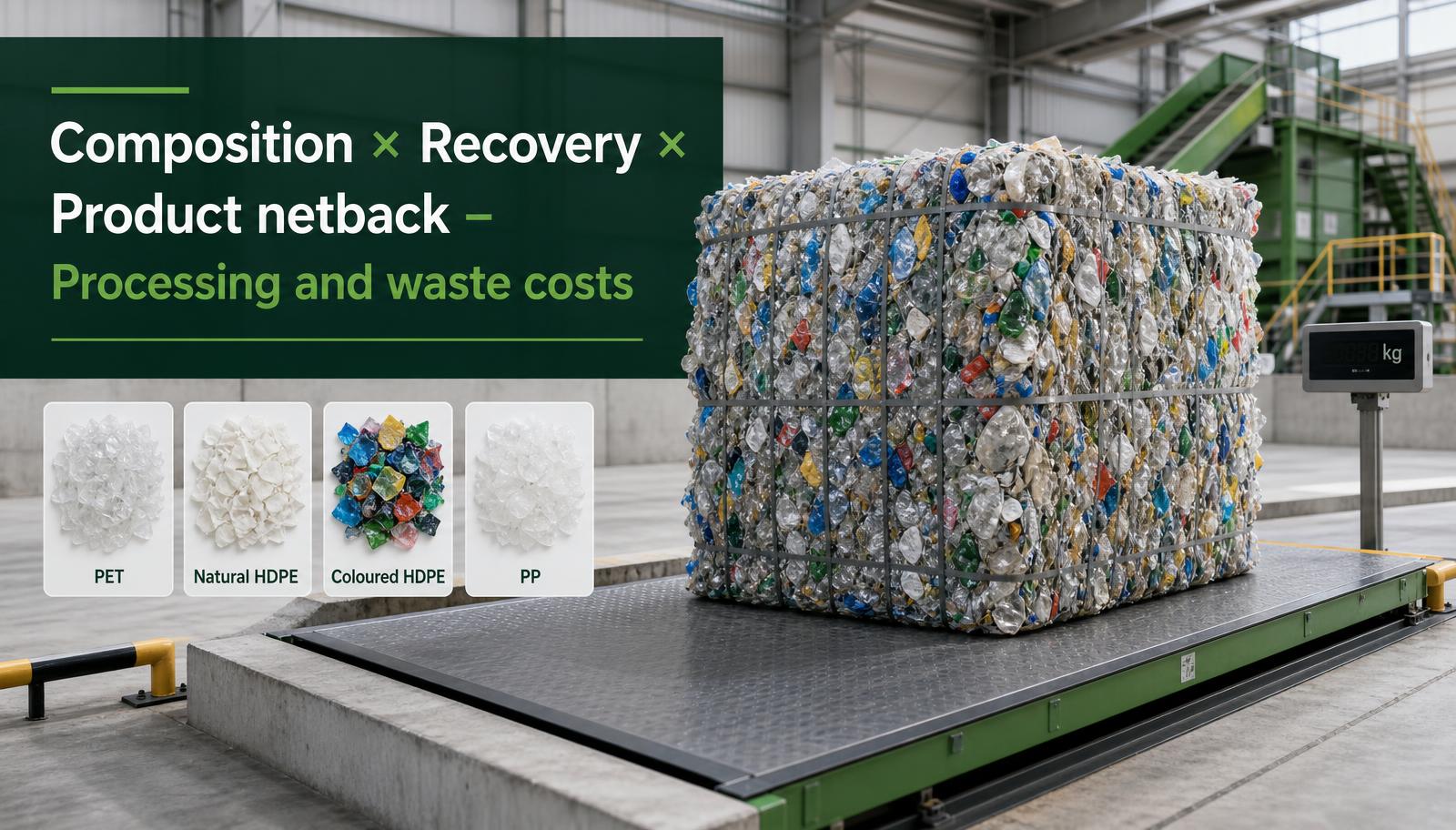
Break the composition into PET, natural HDPE, coloured HDPE, PP, other recoverable outputs and residual waste. Apply separate recovery and product-netback assumptions, charge disposal to the non-recoverable fraction, then deduct shared processing and freight.
This prevents a valuable minority component from being overstated and exposes when a nominally recyclable component has no current outlet or creates more processing cost than revenue.
The Waste Bale Audit Bale Valuation Calculator is designed around this material-by-material approach.
Convert the result into a buying decision
Net contribution is not the final decision. A facility also needs a required margin.
Maximum purchase price
Maximum bale purchase price = Expected recovered-product value − All conversion and waste costs − Required margin
Minimum gate fee
If the recovered outputs do not cover costs and required margin:
Minimum gate fee = All conversion and waste costs + Required margin − Expected recovered-product value
A negative maximum purchase price means the material needs a gate fee or another commercial benefit to be viable under the assumptions used.
Also test whether the load consumes capacity that could process a better-margin grade.
Build a sensitivity range, not one perfect answer
Every bale valuation contains uncertainty. Presenting one number to two decimal places can create false confidence.
Run at least three cases:
- Expected: most likely composition, recovery and product netback.
- Downside: lower target content, weaker recovery or lower selling price.
- Upside: cleaner composition or better recovery, supported by evidence.
If a small purity change turns profit into loss, require stronger sampling, a lower price or contractual quality protection.
For live public market references, check the global recycled-plastics Price Centre. Preserve each observation’s polymer, grade, form, geography, currency, unit, basis and effective date. You can also read how bale quality protects margin during volatile markets.
Make supplier performance part of the model
The best recovery assumption is not a generic industry percentage. It is the facility’s own verified history for a comparable stream.
Track assessed composition, recurring contaminants, recovered yield, waste, quality incidents, claims and load-to-load variability by supplier and grade.
A supplier with a slightly lower average target content may still be commercially preferable if its loads are predictable. Low variability improves production planning, blending decisions and customer-quality performance.
BaleScan can support this process by turning bale photographs and receiving details into an AI-assisted estimate of visible composition and contamination, with a shareable record. It is a screening and documentation layer—not a replacement for representative sampling, laboratory analysis, certified weighing or contractual inspection.
Analyse a plastic bale with BaleScan and compare the receiving estimate with actual plant recovery.
The bottom line
A plastic recycling bale is worth the value of its expected saleable outputs—not the headline price of the finished resin and not the gross tonnes delivered.
Good valuation connects specification, composition, recovery, achievable netback, gate position, conversion, disposal and required margin. Documented inputs help buyers set defensible prices and sellers demonstrate quality.