Recycled-plastic markets moved from weak demand and cheap virgin resin to renewed price volatility in 2026. Recyclers cannot control oil, imports or regulation—but they can control how accurately they value incoming bales.
The global recycled-plastics market has already delivered two very different pricing stories in 2026.
The year began with recyclers under intense pressure from low virgin-polymer prices, weak demand and cheap imports. By the second quarter, geopolitical disruption and higher virgin-resin costs had renewed buyer interest in recycled material across several markets.
The direction changed quickly. The structural problem did not.
Recycled PET, HDPE and PP producers still operate between two volatile markets: the price paid for incoming bales and the price customers will pay for finished flake or pellet. When the spread between those numbers narrows, a few percentage points of contamination can decide whether a load makes money.
That makes bale quality one of the few meaningful margin levers a recycler can control.
Oil, freight, imports and regulation move the market. Composition determines how much saleable material you actually bought.
What is driving recycled-plastic prices in 2026?
There is no single global recycled-plastic price. Every assessment depends on polymer, grade, colour, form, geography, delivery basis and specification.
Clear food-grade rPET pellet is not interchangeable with mixed-colour PET flake. Natural rHDPE carries different economics from coloured rHDPE. Post-consumer recycled PP competes in different applications from clean post-industrial PP.
Even so, four market forces are shaping most regional price conversations.
1. Virgin resin remains the ceiling in many applications
Recycled resin frequently competes against virgin material on price, particularly where recycled content is voluntary.
At the beginning of 2026, the Bureau of International Recycling reported that low virgin-resin costs were undermining demand for recycled feedstock in the United States, Europe and parts of Asia. When converters can switch specifications and buy virgin resin more cheaply, recyclers either reduce prices or lose volume.
North American PET has been particularly exposed. The Association of Plastic Recyclers reported that virgin PET in March 2026 was priced below its 2019 level, while imported recycled PET had reached nearly one-quarter of North American supply. APR also reported PET bale prices falling to only a few US cents per pound in some markets as domestic reclamation capacity contracted.
The precise spread varies by region and grade. The commercial pattern is global: cheap virgin material weakens discretionary demand for recyclate.
2. Geopolitical shocks can reverse the spread quickly
The market can change as soon as virgin supply becomes more expensive or less secure.
In May 2026, BIR reported that Middle East conflict and disruption to shipping and polymer supply had lifted demand for recycled material in multiple regions. Its market update observed increases of 20% to 30% for some recyclates, although movements varied significantly by polymer and market.
This does not mean every recycled grade rose by that amount, or that the increase will persist. It demonstrates how rapidly the relative value of recycled material can change when virgin-resin economics move.
A recycler buying bales against last month’s finished-resin price can therefore be exposed before material has even passed through the plant.
3. Imports are changing regional price formation
Recycled plastics increasingly move through international supply chains. Imports can fill genuine supply gaps, but differences in energy costs, environmental standards, subsidies and verification can also place local reclaimers under pressure.
Europe has experienced its sharpest warning. Plastics Recyclers Europe reported nearly one million tonnes of recycling capacity lost over three years, with further closures expected amid cheap imports, high energy costs and weak demand.
The European Commission has responded by developing separate customs codes for virgin and recycled plastics and increasing scrutiny of imported material. The underlying concern is not simply volume. It is whether imported recyclate is accurately declared, traceable and produced to equivalent standards.
That concern has consequences beyond Europe. Better verification at major import markets will increase the commercial value of consistent specifications, traceable origin and credible quality records throughout the supply chain.
4. Regulation is beginning to create protected demand
Mandatory recycled-content requirements can partially decouple recyclate demand from virgin-resin prices.
The European Union’s Packaging and Packaging Waste Regulation is designed to increase recycled-plastic use and reduce reliance on primary raw materials. Several US states have introduced post-consumer recycled-content requirements for plastic packaging. Similar policy mechanisms are being considered or implemented in other markets.
Mandates do not eliminate price pressure. They change who must keep buying when virgin resin becomes cheaper.
As recycled-content requirements expand, the market is likely to split more clearly between:
- Verified, consistent recycled material suitable for regulated applications
- Lower-spec recycled material competing directly with virgin resin on cost
For recyclers, moving toward the first category requires control of feedstock quality and documentation—not only additional processing capacity.
Why headline prices can mislead bale buyers
A published rPET or rHDPE price is not automatically the value of an inbound bale.
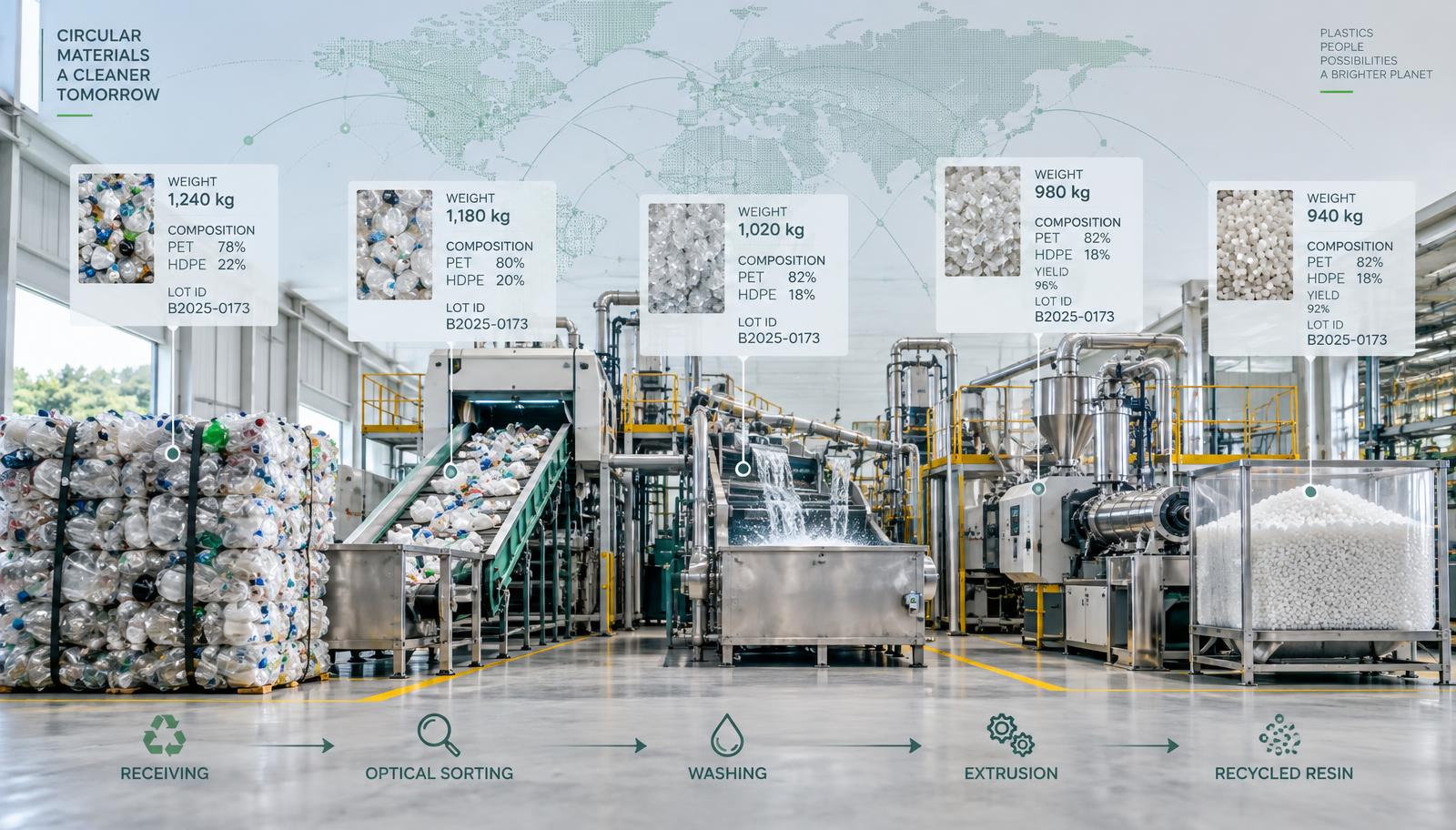
The finished-resin price must fund the entire conversion process: inbound freight, sorting, washing, drying, extrusion, filtration, testing, packaging, waste disposal and yield loss. The bale’s recoverable target material is what carries that cost—not its gross weight.
| Price or value | What it represents | Common mistake |
|---|---|---|
| Virgin resin price | New polymer for a defined grade and delivery basis | Treating it as a direct benchmark for all recycled grades |
| Recycled pellet price | Finished recyclate meeting a specification | Applying it to unprocessed bale tonnes |
| Washed flake price | Intermediate product with defined quality | Ignoring further yield and conversion costs |
| Bale price | Compressed collected material before reprocessing | Assuming every tonne contains the same recoverable polymer |
| Net recoverable value | Saleable output less conversion and waste costs | Failing to calculate it by supplier or load |
The more volatile the resin market becomes, the more dangerous these shortcuts are.
A simple example: the contamination spread
Consider two 20-tonne PET bale loads purchased at the same price per tonne.
- Load A: 90% estimated target PET
- Load B: 78% estimated target PET
Before normal process losses, Load A contains approximately 18 tonnes of target material. Load B contains approximately 15.6 tonnes—a difference of 2.4 tonnes.
The lower-quality load may also create more sorting labour, waste disposal, downtime and quality risk. If the finished rPET market falls between purchase and sale, those lost tonnes become even more expensive because the recycler has less margin available to absorb them.
This is an illustrative composition comparison, not a guaranteed yield calculation. Actual output depends on moisture, labels, closures, polymer mix, process configuration and final-product specification.
The principle holds across PET, HDPE and PP: a cheap bale can be expensive feedstock when recoverable content is low.
Use the BaleScan contamination cost calculator to test how a purity gap changes monthly feedstock value.
The five numbers every feedstock buyer should track
Market intelligence is useful only when it changes a buying decision. A practical feedstock dashboard should connect external price movement to internal quality performance.
1. Delivered bale cost
Include freight, handling and any fees—not only the supplier’s ex-works price.
2. Estimated target-polymer percentage
Record composition consistently by load, supplier and product type. Avoid treating the supplier’s grade description as a measurement.
3. Actual plant yield
Where possible, reconcile inbound tonnes with saleable flake or pellet, by-product and waste. Composition estimates become more commercially useful when compared with processing results.
4. Conversion cost per saleable tonne
Energy, labour and disposal costs should be divided by saleable output, not simply inbound weight. Poor feedstock usually increases this number from both directions: higher cost and lower output.
5. Finished-product netback
Use the price achievable for the product actually produced, adjusted for freight, claims, rebates and payment terms. Do not substitute a premium published assessment if the plant’s output does not meet that grade.
Together, these numbers create a more defensible maximum bale price:
Maximum feedstock value = expected saleable output value − conversion costs − waste costs − required margin
Quality data becomes more valuable when prices move
In a rising market, sites are tempted to secure tonnes quickly and relax inbound controls. In a falling market, they may focus exclusively on reducing purchase price.
Both reactions can damage margin.
The better response is to price quality explicitly:
- Set target-polymer and contaminant ranges by bale grade
- Photograph and assess loads consistently, not only when visibly poor
- Track supplier average quality and variability
- Apply agreed downgrade or rejection rules
- Give suppliers evidence while the delivery is still traceable
- Compare estimated composition with actual plant yield
A supplier delivering 88% target material consistently may create more value than one averaging 90% but moving unpredictably between 75% and 96%. Variability affects production planning, blending, quality risk and working capital.
For a practical audit framework, see the Waste Audit Guide for Recyclers and MRFs.
A global market rewards evidence
As recycled plastics become more internationally traded and more heavily regulated, buyers will increasingly ask not just whether material is recycled, but:
- Where it originated
- What it contains
- How it was processed
- Whether its specification is repeatable
- What evidence supports the claim
This is not limited to one country’s compliance system. It is a basic requirement of a market trying to differentiate verified recycled material from cheap virgin resin, wide-spec material and poorly documented imports.
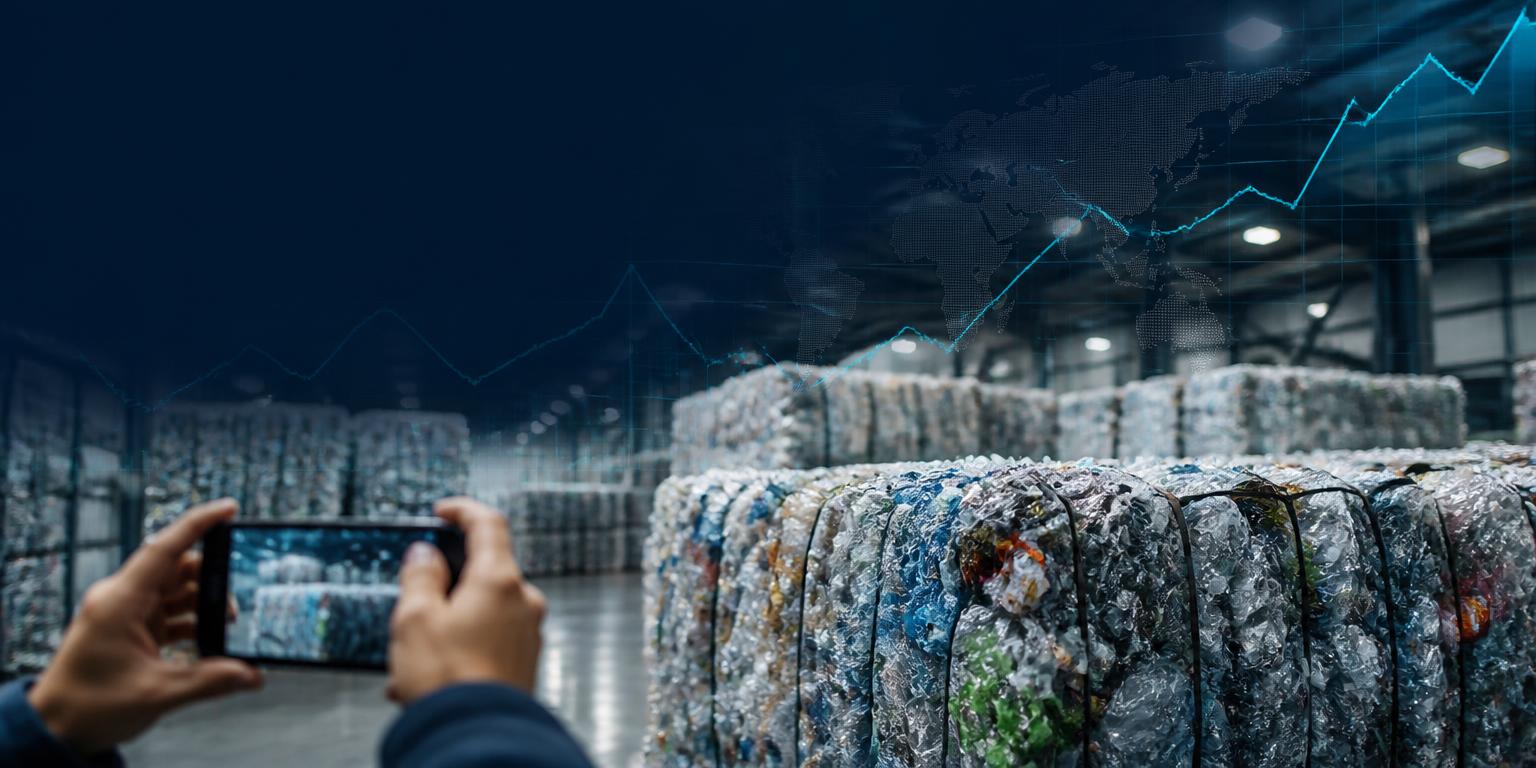
For bale buyers, traceability begins at receiving. A timestamped record that connects photographs, estimated composition, supplier, grade and inspection notes creates a foundation for supplier management and downstream verification.
Protect margin before the bale reaches the line
No recycler can control the global oil price, a shipping disruption, a new import flow or the timing of regulation.
Recyclers can control how consistently they inspect incoming material, how quickly they identify contamination and how accurately they translate quality into price.
That is the practical hedge in a volatile recycled-plastics market: know what is inside the bale before its full cost disappears into production.
Turn a bale image into a documented quality record
BaleScan uses a smartphone image to generate an AI-estimated plastic-bale composition breakdown, contamination summary and shareable report. It helps receiving teams document quality consistently and build comparable supplier records without specialist scanning hardware.
Image-based results are estimates and do not replace representative manual sampling, laboratory testing or contractual inspection requirements. They provide a fast screening layer that helps teams decide where deeper investigation is needed.
Scan a plastic bale free—no card or account is required for the initial scan.
Frequently asked questions
Are recycled-plastic prices rising or falling in 2026?
Both movements have occurred. Early 2026 was characterised by low virgin-resin prices and weak recycled demand in several regions. Geopolitical and supply disruptions later increased virgin prices and renewed demand for some recyclates. Direction varies by polymer, grade, region and delivery basis.
Why do virgin-plastic prices affect recycled-plastic prices?
Where recycled content is voluntary, converters can often switch between virgin and recycled resin. Cheap virgin material therefore places a ceiling on recycled prices. Mandatory recycled-content requirements can protect part of recyclate demand.
Is there one global price for recycled PET, HDPE or PP?
No. Prices vary by polymer, colour, food-contact status, recycled-content origin, form, specification, region, volume and delivery terms. Any useful comparison must define these attributes and the pricing date.
How does bale contamination affect feedstock value?
Contamination reduces the target polymer available for sale and can increase sorting, washing, downtime, filtration and disposal costs. Gross bale weight therefore overstates usable feedstock when purity is poor.
What should a recycler compare between suppliers?
Track delivered price, estimated composition, actual yield, recurring contaminants, quality variability, waste cost and claims. Lowest purchase price alone does not identify the lowest-cost feedstock.
Can a photo determine the contractual quality of a bale?
Not by itself. Image analysis supports rapid screening and documentation, but contractual acceptance should follow the sampling, testing and inspection methods agreed by buyer and seller.
Sources
- OECD—Global Plastics Outlook
- Bureau of International Recycling—May 2026 plastics market update
- Bureau of International Recycling—February 2026 plastics market update
- Association of Plastic Recyclers—Record production and imports jeopardise PET recycling
- Association of Plastic Recyclers—2024 US post-consumer plastics study
- Plastics Recyclers Europe—European recycling industry data
- European Commission—Circular Plastics Alliance relaunch