The EU Packaging and Packaging Waste Regulation entered into force on 11 February 2025 and its main obligations apply from 12 August 2026. That date is not a distant compliance milestone any more — it is this week. For recyclers, converters and brand owners, the practical consequence is that recycled content stops being a marketing claim and becomes a documented, auditable quantity.
This article covers what changes on that date, why verification and traceability have become the industry''s pressure point, and what a materials recovery facility should have in place to keep selling into compliance-driven demand. It is written for operators, not lawyers: the focus is on evidence you can produce from your own yard.
Key Takeaways
- Regulation (EU) 2025/40 entered into force in February 2025 and applies progressively, with main obligations from 12 August 2026.
- The European Commission published guidance and FAQs in March 2026 clarifying how key provisions will be interpreted.
- Recycled-content targets for 2030 are driving demand for verified, traceable recyclate — not just recyclate.
- European recyclers have flagged unverified imported material as a direct competitive threat.
- Facilities that keep per-bale composition records are already producing the evidence the value chain now asks for.
What Actually Changes on 12 August 2026
The European Commission''s packaging waste framework confirms that PPWR covers all packaging regardless of material or origin, setting requirements for manufacturing, composition, recoverability and waste management. From 12 August 2026 the bulk of those obligations begin to apply, replacing the older directive-based approach with a single directly applicable regulation.
In March 2026 the Commission published a guidance document and FAQs interpreting key provisions — a signal of how seriously enforcement is being prepared and a useful indication of how definitions will be applied in practice. Legal analysts have noted these documents are likely to shape enforcement across member states.
From Directive to Regulation
The shift matters operationally. A regulation applies directly and uniformly, reducing the national variation that let some suppliers arbitrage the weakest interpretation. If your material crosses borders, the compliance target is now more consistent — and harder to sidestep.
A Broader Definition of Producer
PPWR widens who counts as a packaging producer, pulling more actors into reporting duties. Those duties cascade upstream as documentation requests: your buyer''s obligation quickly becomes your paperwork.
Why Verification Is the Real Battleground
Recycled content only counts if it can be substantiated. Plastics Recyclers Europe has warned that cheaper imported recyclate — sometimes accompanied by questionable recycled-content claims and without effective verification or traceability — is undermining domestic recyclers and putting the 2030 targets at risk. That is a verification problem dressed as a pricing problem.
The commercial effect for a compliant recycler is counterintuitive: the better your documentation, the more valuable your material becomes relative to cheap imports, because your buyer can actually use your tonnes in a regulated claim. Undocumented material competes on price alone.
Chain of Custody Starts at the Bale
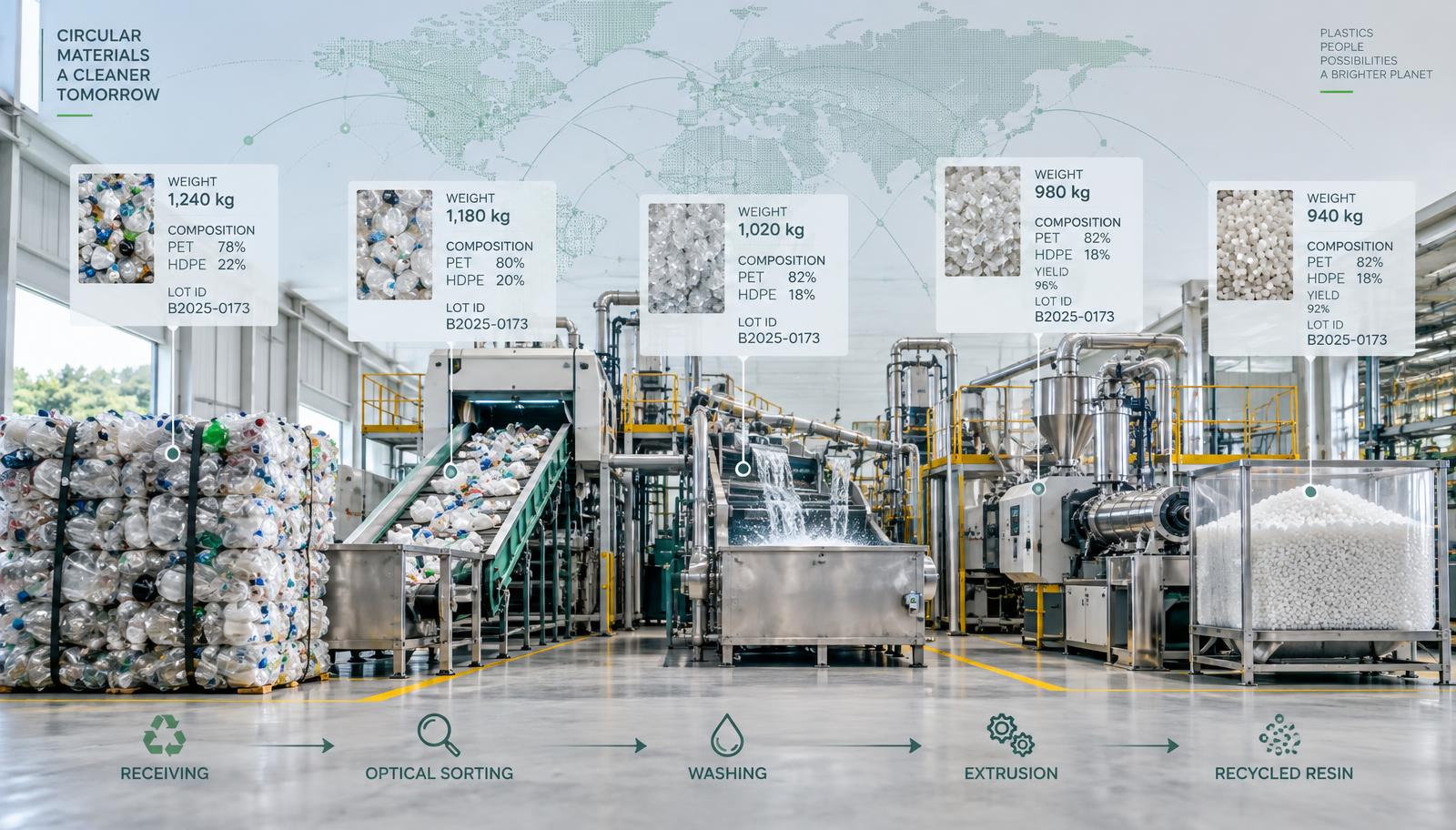
Every recycled-content claim traces back through pellet, flake and wash line to a bale that arrived at a gate. If nobody recorded what was in that bale, the chain has a gap at its origin. A timestamped composition record with the load closes it.
What Buyers Are Asking For
The requests are becoming standard: material type breakdown, contamination percentage, date and location of assessment, and an identifiable record per load. None of that requires a laboratory. All of it requires a habit.
The 2030 Targets and the Supply Gap
Analysts across the sector expect regulated recycled-content demand to outpace available high-quality mechanical output later this decade. Plastics Recyclers Europe has estimated a shortfall measured in millions of tonnes if rigid HDPE and PP recycling continues to plateau, and consultancies covering circular plastics point to chemical recycling being relied on to help close the gap.
For a MRF, a structural shortage of compliant material is good news with a condition attached: the shortage is in qualifying material. Bales that cannot support a documented claim do not participate in that upside.
Quality Beats Volume in a Constrained Market
When buyers must hit a legal percentage, they buy the material that will definitely deliver it. A slightly cheaper bale with an unknown contamination profile is a compliance risk, and compliance risk is priced brutally.
Global Ripple Effects
Joint research by ICIS and Chinese industry bodies has examined how EU circularity rules reshape global recycled plastics demand across packaging, automotive and textiles. Exporters into Europe are already adapting specifications to match, which raises the documentation bar everywhere.
What This Means Outside the EU
If you operate in Australia, the UK, North America or Asia, PPWR is not your law — but it is very likely your customer''s customer''s law. Multinational brand owners run single global packaging specifications wherever possible, and the strictest jurisdiction usually sets it.
Parallel regimes reinforce the trend. Plastic packaging taxes, extended producer responsibility schemes and national recycled-content mandates all ask the same underlying question: prove it. A facility that can answer once can answer for all of them.
Do Not Wait for Local Legislation
The cost of starting a composition record now is a few seconds per bale. The cost of reconstructing one retrospectively when a customer asks for twelve months of history is that you cannot.
Building an Audit Trail From the Tipping Floor
A defensible audit trail does not require new capital equipment. It requires that four things be true of every load you sell.
It Is Recorded Before Dispatch
Evidence created before the transaction is credible. Evidence created after a dispute is advocacy. Scan at the point of baling or loading.
It Is Specific by Polymer
"Mostly PET" is not a record. A breakdown that separates PET bottle from PET thermoform, natural HDPE from coloured HDPE, and film from rigids is what a downstream claim can be built on.
It Is Timestamped and Attributable
Date, time and the load it belongs to. Without that, a report is a photograph of some plastic.
It Is Retrievable
A searchable history beats a folder of PDFs on a laptop. When a customer audit arrives, retrieval speed is the whole test. Our waste audit guide walks through how to structure this record set for a facility that has never kept one.
Get Your Evidence in Order
From 12 August 2026, the European packaging value chain runs on documented recycled content. The material has to be good and the proof has to exist. Most facilities already produce the material; far fewer produce the proof.
Start building a per-bale audit record so that when the documentation request arrives, you already have the answer.
Frequently Asked Questions
When does the PPWR actually apply?
Regulation (EU) 2025/40 entered into force on 11 February 2025 and applies progressively, with its main obligations becoming applicable from 12 August 2026. Some requirements, including certain recycled-content thresholds, phase in on later dates through 2030 and beyond.
Does PPWR apply to my facility if I am outside the EU?
Not directly, but it applies to packaging placed on the EU market, which means it reaches any exporter and most multinational brand owners. Global packaging specifications tend to be written to the strictest jurisdiction, so the documentation expectations travel well beyond Europe.
What evidence supports a recycled-content claim?
A traceable chain from finished packaging back through pellet, flake and wash line to the incoming bale. At the bale stage that means a timestamped, load-specific composition record identifying polymer types and contamination, retained and retrievable on request.
Why are imported recyclate claims a problem?
European recyclers'' associations have raised concerns that imported material sometimes arrives with recycled-content claims that lack effective verification and traceability. That undercuts domestic recyclers who do document their material, and it is one reason verification requirements are tightening.
Will there be enough recycled material to meet 2030 targets?
Industry bodies have warned of a multi-million tonne shortfall if rigid HDPE and PP recycling output remains flat, and consultancies expect chemical recycling to be relied on to help close the gap. The shortage is concentrated in high-quality, verifiable material rather than tonnage generally.
Do I need laboratory testing to comply?
Laboratory analysis has its place for certification and disputes, but routine commercial documentation is about consistency and coverage. A fast composition record on every load produces a far more useful evidence base than occasional detailed testing on a handful of bales.
How far back should we keep composition records?
Align retention with your customers'' reporting cycles and any local EPR obligations, which commonly means several years. Digital records are the practical answer because retrieval, not storage, is what an audit tests.
What is the fastest way to start?
Begin with outbound loads only. Photograph and scan each bale at dispatch, attach the report to the paperwork, and let the history accumulate. Add inbound supplier sampling once the outbound habit is established.