Relying on manual sight-checks and clipboards to verify material quality is costing your facility more than just time. Every contaminated load that slips through represents a direct financial loss and a potential dispute with your suppliers. You already know that manual audits are labor-intensive and often lack the objective proof needed to settle quality claims. Adopting smartphone bale inspection eliminates this high-stakes guessing game by providing clear, digital evidence right at the loading dock.
You need a faster, more reliable way to protect your margins and ensure material purity. This article explains how smartphone-based AI replaces outdated manual probing to provide instant, verifiable composition data. We'll show you how to generate instant PDF audit reports that create total transparency for every load. You will also see how digital tools like our Pro Plan and Team Plan help you reduce contamination rates and increase throughput. It's time to turn visual surface data into a statistically significant quality audit that makes manual probing obsolete.
Key Takeaways
- Replace slow manual probing with pixel-based analysis to eliminate the primary bottleneck in your MRF scaling.
- Discover how neural networks identify PET, HDPE, and LDPE patterns to provide instant, objective composition data.
- Evaluate the cost-efficiency of smartphone bale inspection compared to expensive, fixed NIR hardware installations.
- Master the specific lighting and positioning techniques required to capture professional-grade audit images at the loading dock.
- Centralize your quality data to hold suppliers accountable and identify long-term contamination trends across your facility.
The Evolution of Plastic Bale Inspection: From Probes to Pixels
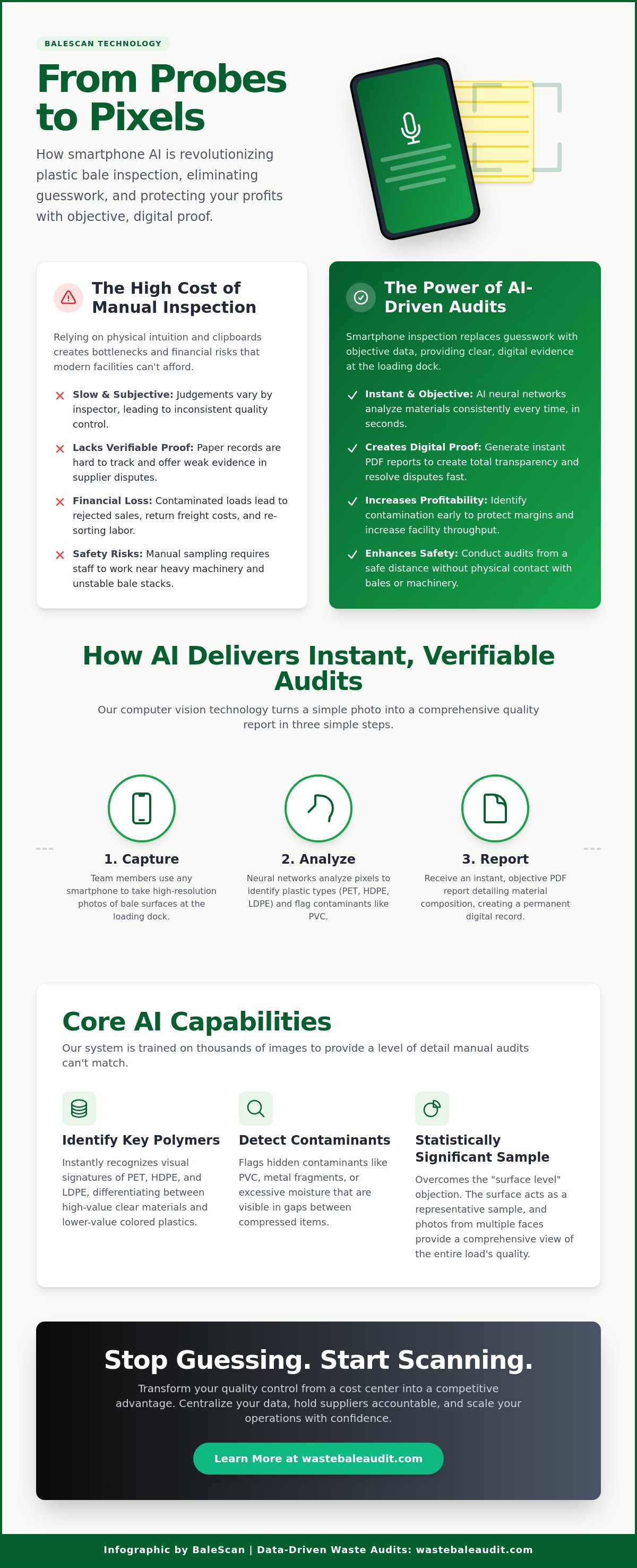
For decades, waste facilities have relied on physical intuition to judge material quality. Inspectors use metal probes to "poke and prod" plastic bales, searching for hidden contaminants like PVC or trapped moisture. This method is slow and highly subjective. One inspector might pass a load that another rejects. As Material Recovery Facilities (MRFs) look to scale, these manual checks have become the primary operational bottleneck. You can't process thousands of tons a month if every load requires a person with a clipboard and a probe. High throughput demands a faster, more consistent approach.
The 2026 global plastics market is defined by tighter purity requirements and higher penalties for contamination. Traditional methods simply can't keep up with the precision needed for modern recycling contracts. This is where smartphone bale inspection changes the workflow. It takes high-end computer vision out of the lab and puts it directly onto the loading dock. By turning visual data into actionable metrics, facilities can identify material types without breaking a single bale wire. This technology democratizes quality control, making professional-grade audits accessible to any team member with a mobile device.
The High Cost of Inaccurate Inspections
A single rejected bale represents a direct hit to your bottom line. You lose the immediate revenue from the sale; you also pay for return freight and the labor needed to re-sort the material. These costs add up quickly when you rely on manual documentation. Paper-based systems are prone to human error and make it difficult to prove your case during supplier disputes. There is also a safety factor to consider. Manual sampling requires staff to work closely with heavy machinery and unstable stacks. Digital tools reduce these risks by allowing for distant, non-invasive visual audits that keep your team out of harm's way.
Digital Transformation in the Waste Stream
Mobile-first technology is the new standard for efficient facility management. By adopting smartphone bale inspection, you replace human guesswork with objective AI grading. This shift allows your team to follow modern waste management principles by focusing on data-driven recovery and transparency. Digital capture also simplifies your ESG reporting. You don't have to hunt through filing cabinets for quality proof. Instead, the data is stored and ready for instant export. Tools like our Team Plan and Pro Plan help you centralize this history. This makes it easy to hold suppliers accountable and optimize your throughput with just a few taps on a screen.
How Smartphone AI Analyzes Bale Composition
Smartphone bale inspection uses advanced computer vision to identify plastic polymers and contaminants directly from high-resolution photos. Instead of relying on a human eye to guess the grade of a load, the software scans for specific visual signatures that define different materials. This process happens in seconds. It provides a level of detail that manual audits simply can't match. By digitizing the inspection, you create a verifiable record that stays with the material throughout its lifecycle.
Neural networks are the engine behind this analysis. These models are trained on thousands of images to recognize the distinct patterns of PET, HDPE, and LDPE. They look for bottle shapes, label types, and even the way light reflects off certain plastics. This allows the system to differentiate between high-value clear PET and lower-value colored materials instantly. The AI doesn't get tired or distracted, ensuring every load is graded with the same level of professional authority.
Identifying Plastic Types with Computer Vision
Distinguishing between PET and PET-G is a common challenge for manual inspectors. However, computer vision identifies subtle visual markers, such as specific structural differences, that separate these polymers. The AI also flags "hidden" contaminants like PVC or metal fragments that might be visible only in small gaps between compressed items. While traditional lab testing takes days or weeks, smartphone bale inspection delivers these results before the truck even leaves the dock. This speed allows for immediate feedback to suppliers, reducing the risk of recurring quality issues.
Overcoming the "Surface Level" Objection
A common concern is that a photo only shows the outside of the bale. In reality, the surface acts as a statistically significant sample of the entire load. If a bale shows high levels of PVC on three different faces, the internal composition is highly likely to follow the same pattern. The AI also detects patterns of inconsistent baling. For instance, if the surface shows "slugs" of contamination rather than even distribution, it flags the load for further review. Maintaining high plastic bale quality requires this level of granular data to prevent downstream processing failures.
Surface analysis provides a reliable proxy for total bale purity because the mechanical baling process creates a homogenous mixture where surface contaminants reflect the overall internal concentration.
To get the most accurate results, lighting and distance are critical. You need clear, even light to avoid shadows that might hide contaminants. Holding the phone about three to five feet away ensures the AI can capture the full texture of the material. If you're ready to modernize your dock workflow, you can start a digital audit today. Our Pro Plan and Team Plan are designed to integrate these insights directly into your daily operations without adding friction to your team's routine.
Smartphone AI vs. Traditional Inspection Methods
Choosing the right inspection method is a trade-off between cost, speed, and accuracy. Traditional manual core sampling involves physically extracting material from the center of a bale. It's a grueling process that can take hours for a single load. In contrast, smartphone bale inspection provides a comprehensive audit in seconds. While manual sampling is thorough, it's impossible to perform on every incoming load without halting your operations. AI offers a scalable alternative that maintains high standards across your entire inventory without the physical strain.
Reliability is where digital tools truly shine. Human inspectors are prone to fatigue and subjective bias. One grader might be more lenient on a Friday afternoon than a Monday morning. AI provides a consistent, repeatable standard for every audit. This level of precision is essential as AI is Revolutionizing Waste Sorting across the global supply chain. By removing the guesswork, you protect your facility from the financial risks of contaminated loads. Consider these speed and efficiency differences:
- Manual Audit: 30 to 60 minutes per bale; requires physical tools and safety gear.
- Fixed NIR Sensors: Instant analysis; requires material to be on a specific conveyor line.
- Smartphone AI: An AI-assisted visual estimate from photographs; works anywhere on the dock or in the yard, and complements rather than replaces sampling and laboratory testing.
Mobile AI vs. Fixed Sorting Sensors
Fixed Near-Infrared (NIR) sensors are powerful but limited by their physical location. They require a massive capital expenditure (CapEx) and significant floor space. If you need to inspect a bale at a supplier's yard or a remote loading dock, a fixed sensor can't help you. Smartphones offer a mobile-first solution with low operational expenditure (OpEx). You don't need to purchase or maintain on-site bale scanning hardware. Instead, a subscription to our Pro Plan or Team Plan turns existing mobile devices into powerful sensors. This flexibility allows your team to conduct audits anywhere, from the warehouse floor to the back of a trailer. Mobile data also complements your existing facility sensors by providing quality verification before material ever hits the belt.
Mobile AI vs. Manual Auditing
Manual auditing is often plagued by "pencil whipping," where staff fill out forms without actually performing the check. This leads to fraudulent reporting and unexpected contamination spikes. Digital smartphone bale inspection eliminates this risk by requiring a timestamped, geo-located photo for every audit. It creates a transparent trail of digital proof that's impossible to fake. Standardizing quality becomes much easier when every facility in your network uses the same AI-driven criteria. Onboarding is also faster. You can train a new hire to use the app in minutes. They don't need years of material expertise to distinguish between PET and HDPE; the software handles the technical identification for them.
How to Conduct a Professional Smartphone Bale Audit
Performing a smartphone bale inspection requires a systematic approach to ensure data accuracy. Safety is the first priority. Before you open the app, verify that the bale is safely positioned on level ground, away from moving forklifts and overhead hazards. Ensure the bale is accessible from multiple sides. If the material is tightly stacked, you may need to move individual units to get a clear view of the representative surfaces. A professional audit is only as good as the physical access you provide the camera.
Once the area is clear, check your environment. Natural daylight is ideal, but artificial facility lighting works if it's consistent. Avoid capturing images where deep shadows or intense glares obscure the material texture. If you're working in an outdoor yard, try to position yourself so the sun is at your back. This reduces lens flare and ensures the AI can clearly distinguish between different plastic polymers and potential contaminants.
Capturing High-Quality Audit Photos
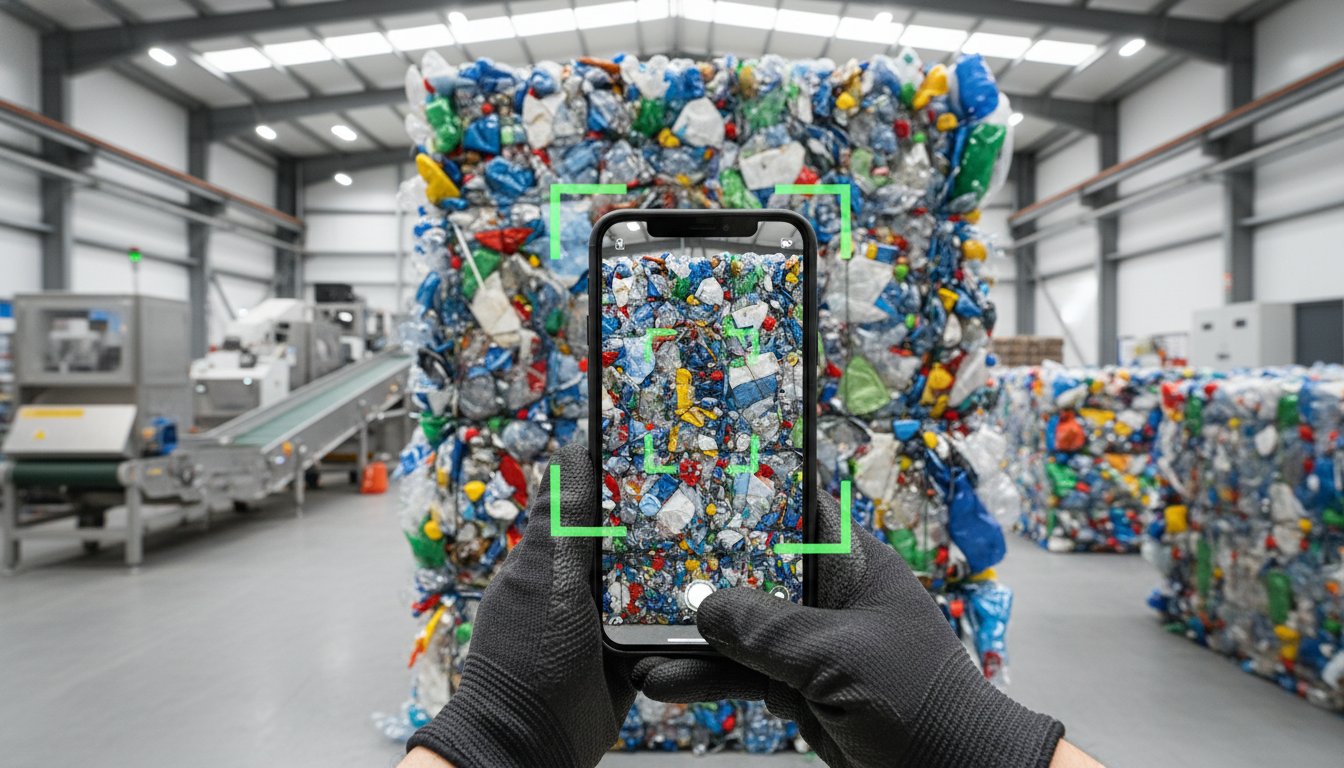
The "Four-Corner" method is the industry standard for comprehensive coverage. Instead of taking a single photo, capture images of at least four different faces of the bale. This provides the AI with a broader dataset to calculate the average purity. Start at the top left corner and move clockwise. Keep your hands steady and wait for the camera to focus before snapping the shot. Position your smartphone camera approximately three to five feet from the bale surface to capture a clear field of view while maintaining high resolution for polymer detection.
If you encounter heavy strapping or plastic wrap, try to find an angle that looks directly at the material. The AI is trained to ignore common packaging materials, but a clear view of the contents always improves accuracy. Repeat this process for every bale in the load to build a complete digital profile of the shipment. This disciplined approach ensures your data remains objective and verifiable.
Interpreting the AI Results
After you upload the photos, the system processes the data instantly. You'll receive a contamination percentage score that reflects the ratio of non-target materials found on the surface. Review the identified plastic type breakdown to see the specific mix of PET, HDPE, or LDPE. If the contamination score exceeds your facility's threshold, flag the bale immediately. This allows you to reject the load or renegotiate the price before the material enters your processing line. You can start your first digital audit now to see these metrics in real-time.
The final step is generating the PDF report. This document includes timestamped photos, the AI analysis, and your facility's grading. It serves as your digital proof for supplier disputes or internal quality logs. With our Team Plan, these reports sync across your entire organization, allowing dock managers and procurement teams to view the same data simultaneously. This transparency speeds up the loading dock throughput and ensures everyone follows the same quality standards.
Scaling Your Operations with BaleScan Technology
Scaling a Material Recovery Facility (MRF) requires more than just faster machinery; it requires better data management. Smartphone bale inspection provides the foundation for this growth by centralizing your quality history. Instead of scattered paper logs, every scan is stored in a secure digital environment. This allows you to perform long-term trend analysis on your material streams. You can identify which months yield the highest contamination or which regions provide the cleanest PET. This visibility helps you make informed procurement decisions that protect your facility's profit margins.
Buyer trust is another critical factor in scaling your business. When you can provide transparent, photo-backed documentation for every shipment, you differentiate your facility from competitors. Buyers are more likely to pay premium prices for material that comes with a verifiable digital audit. BaleScan integrates seamlessly into your existing MRF workflows without requiring new infrastructure or expensive on-site bale scanning hardware. It simply enhances the tools your team already uses every day.
Supplier Accountability and Dispute Resolution
Accountability is often the biggest point of friction in the supply chain. When a load arrives contaminated, you need immediate proof to settle the dispute. With our digital reporting, you can email PDF reports directly from the loading dock to your suppliers. This creates a transparent documentation trail that both parties can trust. By building a "Quality Scorecard" for every supplier in your network, you gain clear leverage in price negotiations. You also significantly reduce the window for claims and chargebacks. Instead of waiting days to identify an error, you flag it the moment the material is unloaded. This rapid feedback loop encourages suppliers to improve their own sorting standards before the next shipment.
Team Management and Reporting
Managing quality across multiple locations is a complex task for any operational leader. Our Team Plan allows you to oversee various users and facilities from a single, centralized dashboard. This ensures that every dock manager follows the same rigorous inspection standards, regardless of their location. A searchable scan history means you can find data from months ago in seconds. If a buyer questions a shipment from last quarter, you can pull up the exact timestamped photos and AI breakdown instantly. This level of visibility eliminates the stress of operational guesswork. It turns your quality control process into a strategic asset. If you're ready to see the difference for yourself, you can start your first 10 scans for free with BaleScan. For larger operations, our Pro Plan provides the expanded capacity needed to manage high-volume throughput across your entire enterprise.
Modernize Your Quality Control Workflow
Transitioning from manual methods to digital audits is a necessity for facilities that want to remain competitive. You've seen how AI identifies PET, HDPE, and LDPE instantly, removing the subjectivity that often leads to financial loss and rejected loads. By adopting smartphone bale inspection, you replace intensive physical labor with digital precision. Results are instant. This shift gives you a searchable digital audit history that protects your facility against disputes and simplifies long-term trend analysis.
True efficiency at the loading dock begins with reliable data. Use these tools to generate instant PDF reports that prove material quality before it ever hits your processing line. Whether you're managing a single local site or a complex national network, digital transparency builds the buyer trust required to scale your operations. It's time to stop guessing and start grading with confidence. Get Started with BaleScan for Free and take control of your material quality today.
Frequently Asked Questions
Can a smartphone really detect different types of plastic in a bale?
Yes, smartphone bale inspection uses neural networks to identify plastic polymers like PET, HDPE, and LDPE through visual analysis. The system recognizes specific shapes, textures, and labels that distinguish one plastic type from another. This process turns a standard mobile device into a high-tech sensor. It allows any staff member to verify material composition without needing a chemistry background or expensive laboratory equipment.
How accurate is smartphone bale inspection compared to manual sorting?
AI-driven inspections provide a level of consistency that manual sorting can't match. Human inspectors often grade materials subjectively, which leads to inconsistent results across different facility shifts. The AI applies the same objective criteria to every scan, every time. This repeatability is vital for facilities that need to maintain strict quality standards and reduce the financial risk of contaminated loads.
Does the AI work on dirty or weathered plastic bales?
The AI is specifically trained to recognize materials in harsh, real-world environments. It can identify polymers even when they are covered in dust, dirt, or have been weathered by outdoor storage. While extreme debris can impact surface visibility, the system is robust enough to provide a statistically significant quality grade under typical facility conditions. Clearer photos always yield the most accurate results.
What happens if the bale is wrapped in wire or plastic film?
Common packaging materials like wire ties and clear plastic wrap are filtered out during the analysis. The neural networks are trained to recognize these as non-target items that don't represent the bale's actual contents. You don't need to remove the strapping to get an accurate scan. Just ensure the camera has a clear view of the material through the gaps or film.
Can I use the reports to dispute quality with my suppliers?
Every scan generates a professional PDF report designed specifically for dispute resolution. These reports include timestamped photos and a detailed breakdown of the identified contamination. This digital proof is much harder for suppliers to contest than a handwritten note or a subjective phone call. It helps you secure chargebacks and improve supplier accountability across your entire network.
Is there a limit to how many bales I can scan per day?
Daily scanning capacity is determined by your specific subscription level. Our Pro Plan and Team Plan are designed to handle high-volume operations at busy loading docks. There are no physical restrictions on how many photos you can take; however, your chosen plan dictates the total number of audits you can process and store in your digital history each month.
Do I need a special camera or attachment for my phone?
You don't need any additional hardware, attachments, or on-site bale scanning hardware to use this technology. The system is designed to work with the standard high-resolution cameras found on modern mobile devices. As long as your phone can take a clear, focused photo, it can perform a smartphone bale inspection. This makes it a cost-effective solution with zero capital expenditure.
How does the AI handle mixed material bales?
The system provides a granular percentage breakdown for mixed material loads. It identifies the dominant polymer and flags the specific types and amounts of contamination found on the surface. This data allows you to see the exact ratio of PET to HDPE in a mixed plastic bale. You can then use this information to determine if the load meets your facility's purity requirements.